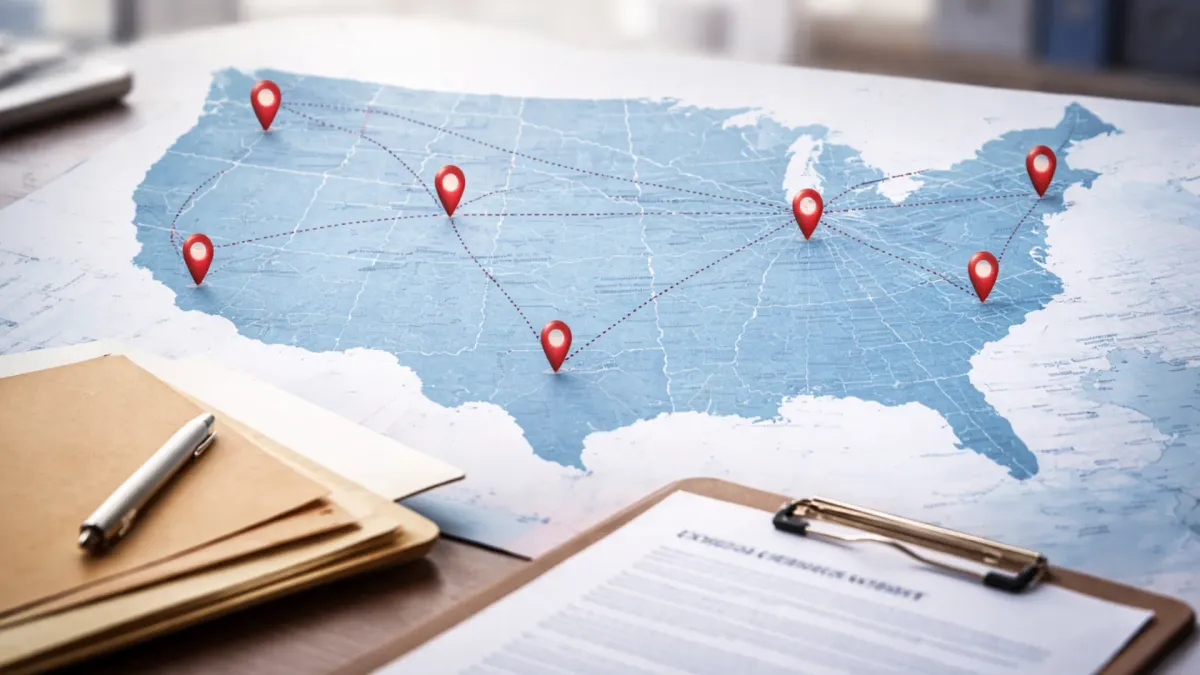
Yes, legal papers can generally be served across state lines, but the service must comply with the applicable court rules and state laws. Because process server requirements and permitted methods of service vary by jurisdiction, hiring a qualified process server in the state where the recipient is located can help ensure proper service and avoid unnecessary delays.
Serving legal papers across state lines is common in lawsuits involving individuals, businesses, witnesses, or defendants located outside the state where a case was filed. Attorneys, law firms, businesses, and individuals may all encounter situations where documents must be delivered in another jurisdiction.
The important question is not simply whether you can serve legal papers in another state, but how to complete interstate service correctly.
Can Legal Papers Be Served in Another State?
In many cases, yes. Legal documents may be served on a person or business located in another state.
However, interstate service of process is not necessarily as simple as sending documents to any process server and asking them to deliver the papers.
Depending on the case and jurisdiction, the rules may address:
Who is legally permitted to serve the documents
Which methods of service are allowed
Whether personal, substituted, mailed, or another form of service is permitted
Deadlines for completing service
What information must appear in the proof or affidavit of service
Whether additional court authorization is required
Failure to follow the applicable rules can lead to disputed or ineffective service and may delay the case.
How Does Interstate Service of Process Work?
Interstate service of process occurs when legal documents issued in one state must be served on a person or entity located in another state.
For example, a lawsuit may be filed in California while the defendant currently lives in Texas. The documents would need to be served in Texas even though the underlying case is pending in California.
The exact procedure depends on the type of case, the issuing court, and the jurisdiction where service will occur.
Before attempting service, it is important to determine the rules governing:
The documents being served — Different documents may have different service requirements.
The issuing court — The court handling the case may specify how service must be completed.
The destination state — The state where the recipient is located may regulate who can serve process and how service can be performed.
Proof of service — The completed affidavit or proof must contain the information required for filing with the appropriate court.
Because these requirements can vary, interstate service should be reviewed on a case-by-case basis rather than assuming one procedure applies nationwide.
Do You Need a Process Server in the Destination State?
Using a qualified local process server in the state where the recipient is located is often the most practical approach.
A local process server may already be familiar with state-specific requirements, local procedures, geographic areas, and common issues that arise during service attempts.
Depending on the jurisdiction, there may also be specific requirements regarding the qualifications, registration, licensing, appointment, or eligibility of the person performing service.
Always verify the rules that apply to the particular state and case.
Why Use a Local Process Server for Out-of-State Service?
Hiring a local process server can provide several advantages when serving legal documents across state lines:
Knowledge of state-specific service rules: Local professionals are more likely to be familiar with requirements governing service in their jurisdiction.
Familiarity with the local area: Knowledge of neighborhoods, businesses, courthouses, and local geography can make service attempts more efficient.
Faster service attempts: Sending documents electronically to a process server near the recipient can reduce logistical delays.
Proper documentation: An experienced server can prepare a proof or affidavit of service documenting when, where, how, and on whom service was completed.
Better communication: Professional process servers can provide updates regarding attempts, address problems, and completion of service.
These advantages become particularly important when deadlines are approaching or the recipient may be difficult to locate.
What Documents Can Be Served Across State Lines?
A variety of legal documents may require out-of-state service, depending on the case and applicable law. Examples can include:
Summonses and complaints
Subpoenas
Divorce and family law documents
Small claims documents
Eviction-related documents
Civil lawsuit documents
Orders and notices
Post-judgment documents
Business and corporate litigation documents
The rules for serving each type of document can differ. A subpoena, for example, may involve different jurisdictional and procedural requirements than a summons and complaint.
Can You Serve an Out-of-State Subpoena?
Serving a subpoena across state lines can be more complicated than serving ordinary civil documents.
A subpoena issued by a court in one state does not automatically have the same authority in another state. Depending on the circumstances, additional procedures may be necessary before a subpoena can be served or enforced in the state where the witness or records are located.
Many states have adopted procedures based on the Uniform Interstate Depositions and Discovery Act (UIDDA), which can simplify obtaining discovery from individuals or entities located in another state.
Because subpoena requirements vary by jurisdiction, attorneys and litigants should confirm the applicable rules before arranging service.
What Happens After the Papers Are Served?
After successful service, the process server typically completes a proof of service or affidavit of service documenting the details of the serve.
Depending on the jurisdiction and case, this documentation may include:
Name of the person served
Date and time of service
Location of service
Method of service
Description or identity of the person served
Documents delivered
Process server information
Signature or sworn declaration
The proof of service may then need to be filed with the issuing court or returned to the attorney, law firm, or individual who requested service.
Accurate documentation is essential because it creates the record showing that service was completed.
Common Mistakes When Serving Legal Papers Across State Lines
Interstate service can create problems when parties assume that the rules are identical in every state.
Common mistakes include:
Hiring someone who is not legally qualified to serve process
Using a method of service that is not permitted
Serving the wrong individual or business representative
Missing a service deadline
Failing to document service attempts properly
Using an incorrect proof of service form
Assuming subpoena procedures are the same as ordinary service
Failing to check both court rules and applicable state requirements
Correcting improper service can cost additional time and money and may interfere with court deadlines.
How Long Does Out-of-State Service of Process Take?
The amount of time required to serve legal papers in another state depends on several factors, including:
Accuracy of the recipient's address
Distance and location
Number of attempts required
Recipient availability
Whether the recipient is avoiding service
Local process server availability
Court deadlines
Special service requirements
Straightforward serves may be completed quickly, while difficult-to-locate or evasive recipients can require multiple attempts or additional investigation.
Providing complete and accurate information to the process server can help improve efficiency.
Tips for Successful Interstate Service
Before sending documents to another state for service:
Verify the recipient's most current address.
Confirm the applicable service deadline.
Identify any special instructions from the issuing court.
Determine whether the destination state has process server qualification requirements.
Send complete, legible copies of every document that must be served.
Provide useful identifying information when appropriate.
Confirm what proof or affidavit of service will be required after completion.
For complicated matters, consult the applicable court rules or a qualified attorney before proceeding.
Frequently Asked Questions About Serving Legal Papers Across State Lines
Can a process server serve papers in another state?
Potentially, but whether a particular process server can personally perform service in another state depends on the laws and qualification requirements of that jurisdiction. Using a qualified server located in the destination state can simplify the process.
Do legal papers have to be served in the state where the lawsuit was filed?
No. A defendant or other recipient may be located outside the state where the case is pending. When permitted by applicable law and court rules, documents can be served where the recipient is located.
Can I mail legal papers to someone in another state?
Mail may be an authorized method of service in some situations, but it is not universally sufficient. The acceptable method depends on the document, court, jurisdiction, and applicable procedural rules.
What if the person refuses to accept the papers?
Refusing to physically take documents does not necessarily prevent valid service. What constitutes proper service depends on the applicable law and the circumstances. An experienced process server should document exactly what occurred during the attempt.
What if I don't know where the person lives?
A professional process serving company may offer or coordinate skip tracing or other lawful investigative services to help locate an individual before attempting service.
Is interstate service of process legal?
Yes. Serving legal documents across state lines is a routine part of litigation, provided the service complies with the rules and laws applicable to the particular case.
Need to Serve Legal Papers in Another State?
Serving legal papers across state lines does not have to be complicated. The key is identifying the applicable requirements and working with qualified process servers who understand the rules in the jurisdiction where service will take place.
Whether you need to serve a summons and complaint, subpoena, family law documents, or other court papers, coordinating with an experienced process serving company can help reduce delays and ensure every service attempt is properly documented.
Finding Reliable Out-of-State Process Servers
Coordinating service in another state does not have to be complicated. The Mighty Process Server Directory helps attorneys, law firms, and individuals find experienced and professional process servers nationwide. The directory connects users with trusted local servers who understand their state laws and can handle interstate service efficiently.
Instead of spending time searching or relying on uncertain referrals, the Mighty Process Server Directory provides a centralized resource to locate qualified process servers across the United States.
Final Thoughts
Yes, legal papers can be served across state lines, but accuracy and compliance are critical. Each state has its own service of process requirements, and working with a knowledgeable local process server is the best way to ensure proper service. Using tools like the Mighty Process Server Directory helps streamline the process while reducing the risk of service errors.
Stay sharp. Stay informed. Live Mighty!
Read the full article at www.mightyprocessserver.com
This article is published by Process Server Daily, powered by MightyAutomation.ai, the leader in legal support intelligence.