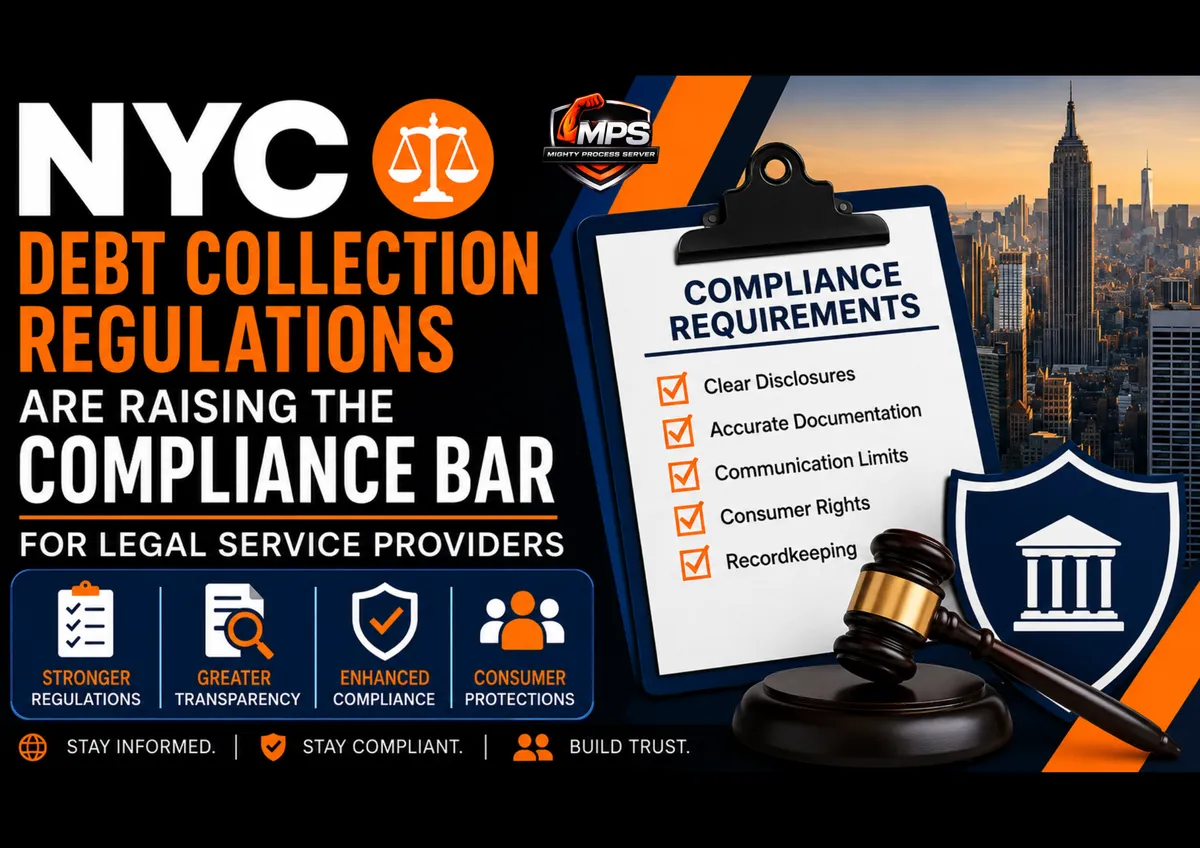
NYC Debt Collection Rules Are Changing — What Process Servers and Legal Professionals Need to Know
By Mighty Process Serving
New York City continues to raise the compliance bar for debt collection, creating new considerations for collection agencies, attorneys, creditors, and the legal support professionals who work alongside them.
At the same time, uncertainty surrounding the future direction of the Consumer Financial Protection Bureau (CFPB) has raised a bigger question: if federal debt collection enforcement changes or becomes less aggressive, will state and local regulators step in to fill the gap?
For process servers in NYC, the issue is especially important. Process servers generally are not debt collectors simply because they serve legal papers, but they frequently work on debt collection lawsuits where accurate service, detailed records, and defensible affidavits can directly affect whether a case moves forward.
As NYC debt collection regulations become more demanding, documentation and compliance are becoming more than administrative requirements. They are increasingly part of what law firms and collection clients expect from professional legal service providers.
Why NYC Debt Collection Regulations Matter
Debt collection has long attracted regulatory scrutiny because of concerns involving inaccurate debts, misleading communications, insufficient documentation, improper collection practices, and consumers' ability to understand and dispute claims.
New York City has developed a particularly robust local framework for regulating debt collection activity.
For collection agencies and other covered businesses, this can mean complying with requirements that go beyond the baseline protections established under federal law.
That makes New York City an important example of a broader trend in consumer finance: state and local debt collection laws can remain highly consequential regardless of what happens with federal enforcement priorities.
For attorneys and legal support providers handling debt collection matters, understanding this overlapping regulatory environment is essential.
NYC vs. Federal Debt Collection Laws: What's the Difference?
A major compliance challenge is understanding the relationship between NYC debt collection laws and federal debt collection laws.
At the federal level, the Fair Debt Collection Practices Act (FDCPA) establishes protections governing many third-party debt collection practices. Federal regulations and CFPB interpretations have further shaped areas such as consumer communications, disclosures, validation information, and electronic communications.
New York City can impose additional requirements on businesses subject to its jurisdiction.
Depending on the activity and entity involved, local rules may address issues such as:
Required consumer disclosures
Debt validation and verification
Communication practices
Recordkeeping
Licensing requirements
Disputed debts
Consumer complaints
Prohibited collection practices
The practical takeaway is important: complying with federal debt collection law does not automatically mean a business has satisfied every applicable New York City requirement.
Organizations operating in NYC must determine which federal, state, and local rules apply to their specific activities.
Why the CFPB's Future Matters to Debt Collection
The Consumer Financial Protection Bureau has played a major role in federal consumer financial protection since its creation.
In the debt collection industry, the CFPB has influenced compliance through rulemaking, supervision, enforcement actions, consumer complaint data, and interpretations of federal consumer financial laws.
The Bureau's Regulation F, for example, implemented rules under the FDCPA addressing areas such as debt collection communications and required disclosures.
For years, collection agencies, financial institutions, law firms, and compliance professionals have watched CFPB actions closely when developing their internal policies.
Changes to the Bureau's enforcement posture can therefore have consequences throughout the debt collection ecosystem.
What Happens If CFPB Debt Collection Enforcement Changes?
Changes in federal enforcement would not necessarily eliminate the underlying federal laws governing debt collection.
That distinction matters.
Even if CFPB enforcement priorities, staffing, policies, or regulatory strategies change, organizations still need to evaluate their obligations under applicable federal statutes and regulations.
Meanwhile, state attorneys general, state regulators, municipal agencies, and private litigants may continue playing significant roles in consumer protection enforcement.
That creates the possibility of an increasingly fragmented compliance environment.
Instead of asking only:
"What does federal law require?"
collection businesses may increasingly need to ask:
"What does federal law require, what does the state require, and what additional rules apply in this city?"
For companies operating across multiple jurisdictions, that can make compliance considerably more complicated.
Could NYC Become Even More Important if Federal Oversight Declines?
New York City already maintains significant consumer protection rules, so any shift in federal enforcement could make local regulation even more important to businesses operating within the city.
This does not necessarily mean NYC will replace federal enforcement.
Rather, it demonstrates why debt collection companies cannot build compliance programs around federal enforcement priorities alone.
A company operating nationally may encounter very different requirements depending on where a consumer lives or where collection activity occurs.
For legal professionals, this creates an additional reason to monitor New York debt collection laws, NYC regulations, court requirements, and federal developments simultaneously.
What NYC Process Servers Need to Know
Process servers occupy a unique position in debt collection litigation.
A process server is generally responsible for delivering legal documents—not collecting the underlying debt. Nevertheless, process servers frequently handle summonses, complaints, subpoenas, notices, and other documents associated with consumer debt cases.
That means the quality of service can become critical.
If service is later challenged, attorneys and courts may examine details such as:
When service occurred
Where service occurred
Who received the documents
What service method was used
Whether required follow-up steps were completed
What information the server recorded
Whether the affidavit accurately reflects the service attempt
For professional NYC process servers, detailed documentation can help attorneys demonstrate that service was performed in accordance with applicable procedural requirements.
Why Proper Service Matters in Debt Collection Lawsuits
Few issues damage confidence in debt collection litigation more than allegations of improper service.
The term "sewer service" has historically been used to describe situations where a process server allegedly fails to serve legal documents properly but records or represents that service occurred.
The consequences can be serious.
Improper service can potentially result in challenges to jurisdiction, motions to vacate default judgments, litigation delays, additional expenses, regulatory scrutiny, and reputational harm.
This is why collection law firms increasingly benefit from working with process serving companies that emphasize documentation, training, accountability, and accurate affidavits.
Professional service of process is not simply about delivering paperwork. It helps protect the integrity of the legal proceeding.
Documentation Is Becoming a Competitive Advantage for Process Servers
In a heavily regulated legal environment, documentation quality can distinguish one process serving company from another.
Law firms, creditors, and collection agencies need vendors they can trust to provide consistent and defensible service records.
High-quality process serving documentation may include:
Accurate affidavits of service
Detailed attempt notes
Reliable dates and timestamps
Addresses and locations of attempts
Descriptions required by applicable rules
Complete chronological service histories
Prompt status updates
Supporting records where legally permitted and appropriate
The objective is straightforward: create a reliable record showing what happened, when it happened, where it happened, and how the assignment was handled.
For process serving businesses, that level of transparency can become a meaningful competitive advantage.
Technology Can Strengthen Process Serving Compliance
Technology is also changing how professional process servers document their work.
Modern process serving software can help agencies create more standardized workflows and maintain better records across assignments.
Depending on the platform and applicable privacy rules, useful capabilities may include:
Electronic timestamps
GPS-supported attempt records
Mobile field updates
Automated status notifications
Digital document storage
Standardized service notes
Affidavit generation
Audit trails
Client portals
Long-term record retention
Technology does not replace knowledge of applicable service rules, but it can help agencies document that their procedures were followed consistently.
For law firms managing hundreds or thousands of debt collection cases, that consistency can be particularly valuable.
How Collection Firms and Process Servers Can Prepare
The evolving regulatory environment makes proactive compliance increasingly important.
Collection agencies, law firms, and legal support providers should consider several practical priorities:
1. Monitor Federal, State, and NYC Rules
Do not rely exclusively on federal regulatory developments. New York State and New York City requirements can create additional obligations.
2. Standardize Service Documentation
Process serving companies should establish clear procedures governing attempts, notes, affidavits, timestamps, and client reporting.
3. Maintain Strong Records
Service records may become important months or even years after an assignment is completed. Appropriate record retention policies can help firms respond to later questions or challenges.
4. Train Field Process Servers
Technology alone cannot prevent compliance problems. Process servers should understand applicable service requirements and the importance of accurate documentation.
5. Audit Internal Procedures
Regularly reviewing affidavits, service records, workflows, and field practices can identify inconsistencies before they become larger problems.
6. Communicate With Legal Clients
Law firms may have specific reporting or documentation requirements. Establishing those expectations before assignments begin can reduce errors and unnecessary delays.
What the Future of Debt Collection Compliance Could Look Like
The future of federal consumer financial regulation remains subject to legal, political, and administrative developments.
But one conclusion is already clear: businesses should not assume that changes at the federal level will eliminate debt collection compliance obligations.
New York City demonstrates why.
State and local governments can establish consumer protection requirements of their own, while existing statutes, court rules, licensing requirements, and private causes of action may continue to apply regardless of changes in federal enforcement priorities.
For collection agencies and attorneys, this means compliance strategies increasingly need to account for multiple layers of regulation.
For process servers, it reinforces the importance of accurate service, detailed reporting, and defensible documentation.
The Bottom Line for NYC Process Servers
NYC's evolving debt collection environment is part of a broader shift toward greater accountability and documentation throughout the legal services industry.
While process servers are not ordinarily responsible for determining whether an underlying debt is valid, they play a critical role in ensuring defendants receive legally required notice of court proceedings.
That responsibility makes proper service and accurate reporting essential.
Whatever happens with future CFPB debt collection enforcement, process servers and legal professionals operating in New York City should continue prioritizing:
Compliance with applicable service rules
Accurate affidavits
Detailed service records
Reliable technology
Staff training
Regulatory awareness
Transparent client reporting
The firms that can demonstrate reliable, documented, and legally compliant workflows will be better positioned to serve attorneys and collection clients in an increasingly complex regulatory environment.
Frequently Asked Questions About NYC Debt Collection Rules
What are the NYC debt collection regulations?
New York City maintains local rules governing certain debt collection activities, including requirements involving licensing, consumer communications, disclosures, recordkeeping, and prohibited practices. Businesses should evaluate NYC requirements alongside applicable New York State and federal laws.
Are NYC debt collection laws stricter than federal law?
In some areas, New York City requirements can impose obligations beyond federal minimum standards. Businesses operating in NYC should therefore avoid assuming that FDCPA compliance alone satisfies every local requirement.
Does the FDCPA apply in New York City?
Yes. Applicable federal debt collection laws can apply in New York City alongside state and local requirements. Which provisions apply depends on the entity, debt, activity, and circumstances involved.
Are process servers considered debt collectors?
Serving legal documents in a debt collection lawsuit does not automatically make a process server a debt collector. However, the precise legal analysis can depend on the activities performed and applicable law. Process serving companies should avoid performing collection activities outside their authorized role without understanding the regulatory consequences.
Why is documentation important for NYC process servers?
Detailed documentation helps establish when, where, and how service was attempted or completed. If service is challenged, accurate records and affidavits can be important evidence supporting the validity of the service.
What happens if the CFPB reduces debt collection enforcement?
Changes in CFPB enforcement would not automatically repeal the FDCPA, Regulation F, or applicable state and local laws. Other regulators and private litigants may also continue enforcing consumer protection requirements.
Article provided by Mighty Process Server (MPS).
Stay sharp. Stay informed. Live Mighty!
Read the full article at www.mightyprocessserver.com
This article is published by Process Server Daily, powered by MightyAutomation.ai, the leader in legal support intelligence.