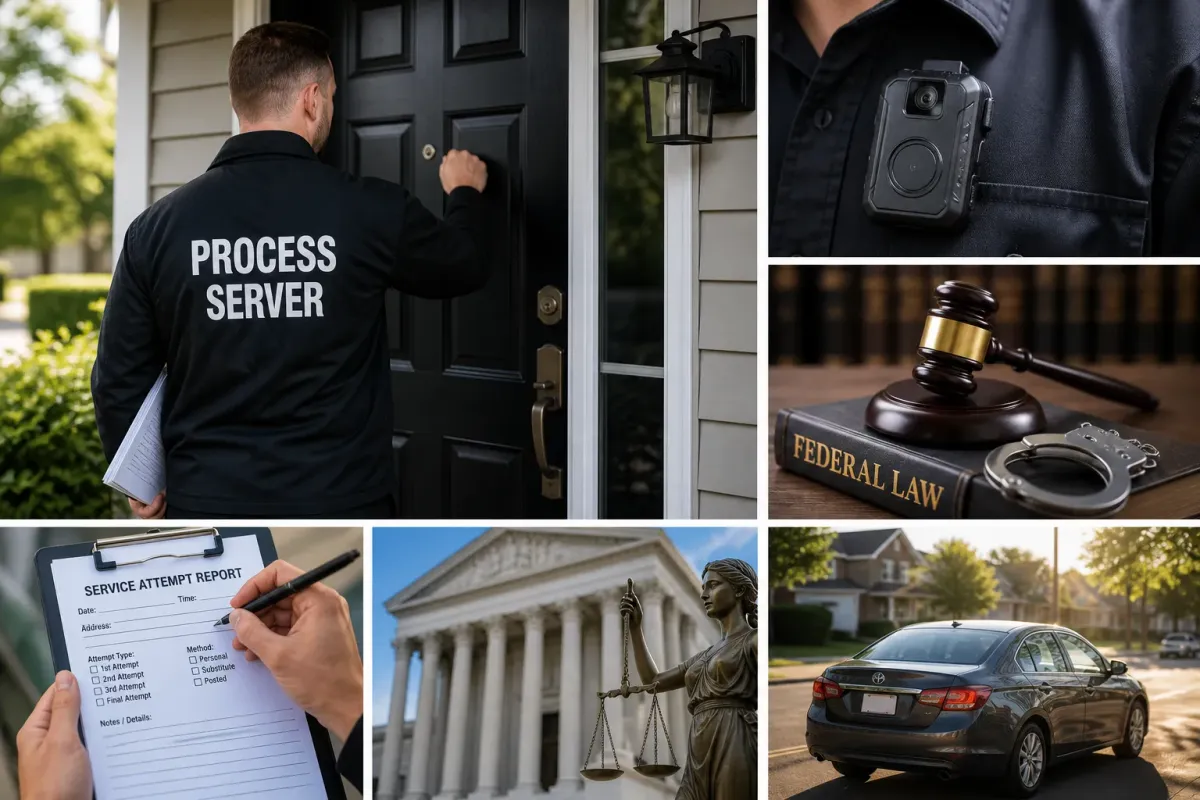
A Practical Safety Standard for Every Attempt: Process Server Safety Standards
Process serving is often routine—until an ordinary service attempt becomes unpredictable.
Professional process servers regularly deliver summonses, subpoenas, complaints, eviction notices, and other legal documents to people facing stressful or high-stakes situations. Most encounters end without incident, but a doorstep interaction can change quickly when a recipient is angry, frightened, confused, or determined to avoid service.
That is why process server safety standards should be more than informal advice passed between experienced servers. A strong safety program creates a repeatable framework for assessing risk, approaching a location, communicating professionally, documenting incidents, and deciding when to disengage.
For process serving companies, independent servers, law firms, and legal support agencies, the goal is straightforward: every attempt should follow a practical safety standard.
Why Process Server Safety Standards Matter
Process servers work in environments they do not control. A server may arrive at a private residence, apartment complex, business, rural property, gated community, or unfamiliar neighborhood with limited information about the people or conditions they will encounter.
Potential hazards can include:
Verbal confrontations and threats
Aggressive or unsecured animals
Hostile family members, roommates, or associates
Visible weapons
Poor lighting or limited visibility
Unsafe parking or difficult exit routes
Intoxicated or emotionally distressed individuals
Environmental hazards around a property
Escalating reactions connected to litigation
The challenge is that many of these risks may not become obvious until the server arrives.
Effective risk management in process serving therefore begins before contact occurs. The objective is not to predict every possible problem. It is to create habits that help a process server identify warning signs, make better decisions, and leave when conditions become unsafe.
The Core Principle: No Serve Is Worth an Unsafe Encounter
A legal deadline may be important, but completing a service attempt should never require unnecessary physical risk.
Process servers should understand the distinction between persistence and escalation. Multiple lawful attempts, careful address verification, better timing, additional research, or coordination with the client may be appropriate. Arguing with an increasingly hostile recipient generally is not.
A practical safety standard gives servers permission to disengage when circumstances exceed reasonable risk thresholds.
That principle should be supported by company policy rather than left entirely to individual judgment.
A Practical Safety Checklist for Process Servers
A consistent safety checklist for process servers can make risk assessment part of every assignment instead of something considered only on obviously difficult jobs.
1. Review the Assignment Before Arrival
Safety begins before the vehicle reaches the address.
Review available information about:
The service address
Type of legal matter
Prior service attempts
Known threats or confrontations
Access restrictions
Relevant client instructions
Property characteristics
Any documented safety concerns
Previous attempt notes can be especially valuable. A warning about an aggressive dog, hostile occupant, inaccessible driveway, or threatening statement should not disappear into an old status update.
Safety information should remain visible to the next server assigned to the job.
2. Conduct a Pre-Approach Safety Scan
Before exiting the vehicle, take a few moments to observe the location.
Consider:
Is there a safe place to park?
Can the vehicle leave without being blocked?
Where are the most practical exit routes?
Are dogs or other animals present?
Are weapons visible?
Are people watching or approaching?
Is there unusual activity around the property?
Are lighting and visibility adequate?
Does anything appear materially different from the assignment information?
This short assessment is one of the simplest process server safety protocols a firm can standardize.
If conditions appear unsafe, document the circumstances and determine whether the attempt should proceed.
3. Maintain Professional Positioning
How a process server approaches a residence can influence the interaction that follows.
Good field habits include:
Keeping identification readily available
Keeping hands visible
Maintaining appropriate distance from the doorway
Avoiding entering a residence unless clearly lawful, necessary, and consistent with applicable policy
Avoiding aggressive gestures or language
Remaining aware of people approaching from the sides or behind
Preserving a clear route away from the property
Professional positioning provides space to communicate while also making disengagement easier if the encounter deteriorates.
4. Use Calm, Limited Communication
Process servers deliver documents. They generally are not there to debate the merits of the underlying case.
Long explanations can create opportunities for conflict.
Useful statements may include:
“I am here to deliver legal documents.”
“I cannot provide legal advice or discuss the merits of the case.”
“Questions about the case should be directed to the issuing attorney or court.”
“I am going to leave now.”
The exact language should reflect applicable law, company policy, and the circumstances of the encounter.
The objective of de-escalation for process servers is not to win an argument. It is to communicate clearly, remain professional, and prevent an unnecessary confrontation.
5. Establish Clear Disengagement Triggers
One of the most important elements of a safety program is deciding in advance what should cause a server to leave.
Potential disengagement triggers can include:
Direct threats
Display or handling of a weapon
Attempts to surround or physically block the server
Rapidly escalating aggression
Uncontrolled aggressive animals
Unsafe environmental conditions
Attempts to force the server into a building or confined area
Any circumstance in which the server reasonably believes remaining would create unnecessary danger
When disengagement becomes necessary, creating distance is generally more important than continuing the discussion.
Servers should follow company procedures and contact emergency services when circumstances warrant it.
6. Use Body-Worn Cameras Consistently and Lawfully
Body cameras for process servers can provide valuable documentation, but their use requires careful policies.
Depending on applicable law, client requirements, privacy considerations, and company procedures, body-worn cameras may help:
Create an objective record of an encounter
Document threats or aggressive behavior
Support incident investigations
Resolve factual disputes
Protect both the process server and recipient
However, recording laws vary by jurisdiction, particularly when audio recording is involved.
Firms using body cameras should establish written policies covering when recording begins, where recording is permitted, how files are stored, who may access footage, how long footage is retained, and when recordings may be disclosed.
Consistency matters. Selective recording can create questions that a uniform policy may help avoid.
7. Document Difficult Encounters Immediately
Memory becomes less reliable as time passes, particularly after a stressful interaction.
After a significant incident, process servers should document relevant facts as soon as reasonably possible.
An after-action report may include:
Date and time
Exact location
Description of the individuals involved
Threats or significant statements
Presence or description of weapons
Aggressive animals
Witnesses
Vehicle descriptions and license plate information when lawfully observed and relevant
Environmental conditions
Actions taken by the server
Reason for disengagement
Whether law enforcement or a supervisor was contacted
Available photographs, video, GPS, or other supporting records
Reports should distinguish observations from assumptions. Objective documentation is typically more useful than emotionally charged conclusions.
Process Serving Tools and Technology That Can Improve Safety
Modern process serving tools and technology can strengthen a safety program when they support—not replace—professional judgment.
GPS and Location-Sharing Tools
Location data can help firms verify where attempts occurred and, when implemented appropriately, provide operational awareness of servers working in the field.
For higher-risk assignments, companies may also establish check-in procedures so another person knows when a server arrives and when the server safely leaves.
Mobile Process Serving Software
Modern field applications can centralize:
Assignment information
Prior attempt notes
Address details
Photographs
GPS information
Attempt documentation
Safety alerts
Client instructions
Real-time status updates
The safety benefit comes from getting relevant information to the server before the approach—not merely storing it afterward.
Research and Address Verification Tools
Lawful research conducted before an attempt may reveal information that changes the approach to an assignment.
Address verification, property research, previous attempt history, and other permissible data sources can help servers avoid unnecessary surprises.
Research should always comply with applicable privacy laws, licensing rules, contractual restrictions, and professional standards.
Body Cameras and Personal Safety Equipment
Depending on jurisdiction and company policy, safety equipment for process servers may include body-worn cameras, flashlights, communication devices, personal alarms, high-visibility equipment, or other tools appropriate to the working environment.
Equipment is most effective when paired with training and clear procedures.
Why Process Server Safety Training Must Be Ongoing
Technology cannot replace judgment.
Strong process server safety training should help professionals recognize developing risks before those risks become emergencies.
Training topics may include:
Situational awareness
Threat recognition
Verbal de-escalation
Conflict avoidance
Safe vehicle positioning
Defensive driving
Professional communication
Incident documentation
Body-camera procedures
Emergency response protocols
Changes in service-of-process laws
Refresher training is important because safety practices can deteriorate when routine assignments create complacency.
Experienced servers need continuing education just as much as new professionals do.
Legal Protections for Process Servers
Process servers should also understand the legal protections and limitations applicable to their work.
For example, 18 U.S.C. § 1501 addresses knowingly and willfully obstructing, resisting, or opposing an officer of the United States—or another person duly authorized—in serving or attempting to serve federal legal or judicial process. The statute also addresses assaulting, beating, or wounding such a person in connection with that service.
That federal provision should not be interpreted as a universal protection covering every state or private civil service attempt. State laws vary, and process servers should understand the rules and protections applicable in the jurisdictions where they work.
Legal protections also do not eliminate physical risk. Good judgment, documentation, and timely reporting remain essential.
Legal Compliance Is Part of Process Server Safety
Legal compliance for process servers and personal safety are closely connected.
Requirements vary significantly by jurisdiction and may govern:
Licensing and registration
Who may serve particular documents
Permissible methods of service
Trespass and property access
Recording and privacy laws
Harassment and misrepresentation
Affidavit and proof-of-service requirements
Data retention and client confidentiality
A server who understands the boundaries of lawful conduct is better positioned to avoid unnecessary confrontation.
Firms should therefore incorporate jurisdiction-specific legal updates into their broader safety program.
Building a Culture of Safety in a Process Serving Company
Safety should not depend on whether an individual server happens to be cautious.
Organizations can create stronger systems through:
Written process server safety standards
Standard pre-approach procedures
Assignment-level risk flags
Clear escalation and disengagement policies
Regular safety training
Incident reporting procedures
Supervisor review of serious incidents
Appropriate field technology
Secure documentation and record retention
Post-incident review and policy improvement
Process serving platforms such as ServeManager, PST, and other industry software may help firms standardize workflows and documentation. However, software alone does not create a safety culture.
The biggest improvement comes when safe behavior becomes the default operating procedure for every assignment.
Turn Every Incident Into Better Information
An incident report should not simply be filed and forgotten.
Organizations can review incidents periodically to identify patterns:
Are particular assignment types producing more confrontations?
Are servers encountering the same hazards repeatedly?
Are important warnings being passed to future servers?
Are certain times or locations associated with greater risk?
Do existing policies give servers enough guidance about when to disengage?
Does additional training appear necessary?
This transforms individual experiences into institutional knowledge.
Over time, a firm's safety program becomes stronger because every significant encounter helps improve the next attempt.
A Simple Safety Standard for Every Service Attempt
A practical field standard can be summarized in six steps:
Review the assignment and previous attempt information.
Observe the location before approaching.
Position yourself so you can communicate without becoming trapped.
Communicate briefly, calmly, and professionally.
Disengage when risk exceeds reasonable limits.
Document significant facts immediately after the attempt.
These steps are simple enough to become routine but comprehensive enough to improve consistency across a process serving operation.
Frequently Asked Questions About Process Server Safety
What are the most important safety tips for process servers?
Situational awareness, safe vehicle positioning, professional communication, maintaining an exit route, recognizing escalation, and documenting unusual incidents are among the most important practices. Servers should also follow jurisdiction-specific laws and company safety procedures.
Should process servers wear body cameras?
Body cameras can provide useful documentation, but recording and privacy laws vary. Process servers should confirm applicable state and local requirements and follow client and company policies before recording.
What should a process server do if a recipient becomes threatening?
The priority should be personal safety. Avoid arguing, create distance, disengage when necessary, and follow company procedures for reporting the incident. Emergency services should be contacted when circumstances warrant.
How can process serving companies improve field safety?
Companies can establish written policies, provide recurring training, flag known risks, maintain incident reporting systems, improve communication with field servers, and use technology to make relevant assignment information available before an attempt.
Why is documentation important after a dangerous service attempt?
Prompt documentation creates a contemporaneous record of what occurred. It can help inform future attempts, support client communications, assist incident investigations, and provide evidence if an encounter later becomes disputed.
Conclusion: Make Safety a Standard, Not an Exception
Professional process serving requires persistence, but it also requires judgment.
The strongest process server safety standards do not depend on improvisation after something goes wrong. They establish repeatable procedures before the server ever reaches the door.
By combining pre-approach assessments, situational awareness, de-escalation techniques, clear disengagement rules, lawful technology use, accurate documentation, and ongoing training, process serving firms can reduce unnecessary risk while maintaining professional and defensible field operations.
Most service attempts will remain uneventful. The purpose of a strong safety standard is to make sure process servers are prepared for the ones that are not.
Safety should be part of every attempt—not just the difficult ones.
Stay sharp. Stay informed. Live Mighty!
Read the full article at www.mightyprocessserver.com
This article is published by Process Server Daily, powered by MightyAutomation.ai, the leader in legal support intelligence.