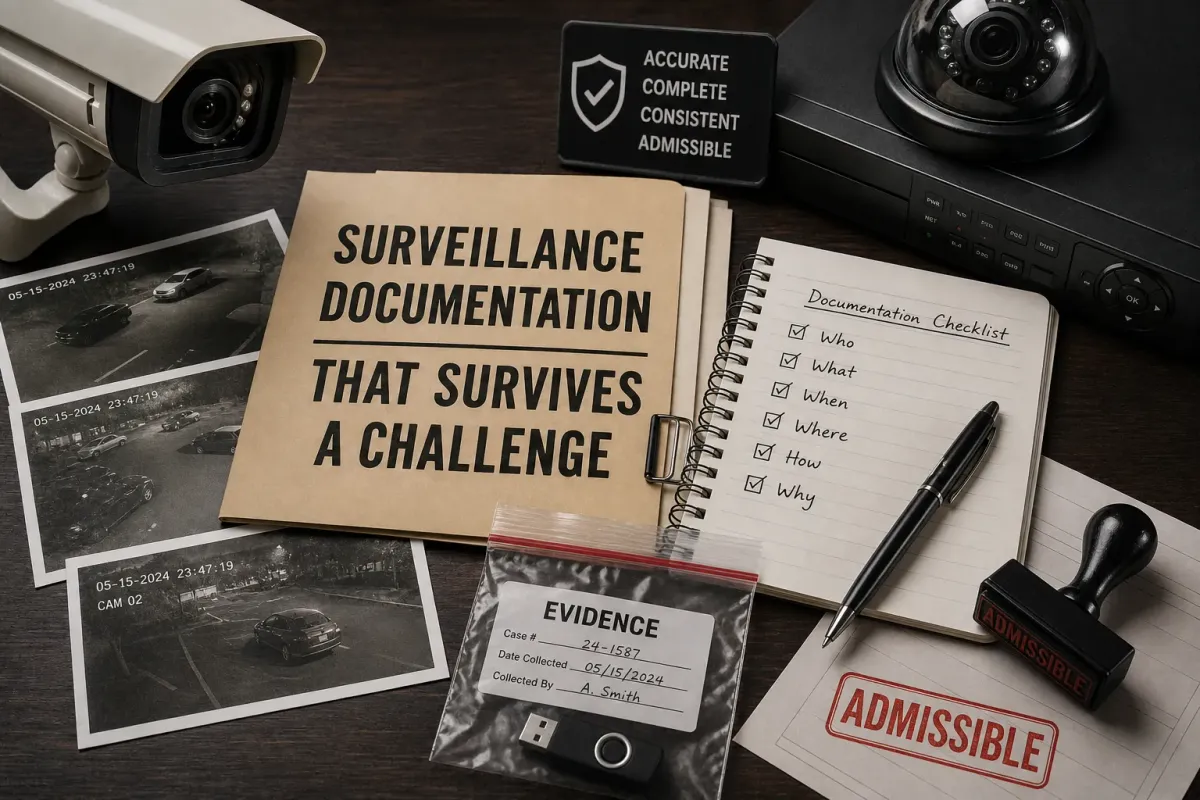
Surveillance Documentation: Building Court-Ready Records That Stand Up to Scrutiny
In legal proceedings, facts matter. Just as important is the ability to prove how those facts were gathered, recorded, and preserved. Whether the assignment involves address verification, witness location, surveillance activities, or an evasive service attempt, documentation often becomes the deciding factor when a case is challenged.
For process servers, private investigators, attorneys, and law firms, strong surveillance documentation provides the foundation for credibility and defensibility. The question is rarely limited to what was observed. Courts, clients, and opposing counsel often want to know whether the work was conducted lawfully, professionally, and accurately documented.
As technology expands investigative capabilities while privacy expectations continue to evolve, maintaining reliable documentation standards has become more important than ever.
Introduction to Surveillance Documentation
Surveillance documentation refers to the detailed records created during surveillance and investigative activities. These records capture observations, evidence, timelines, and supporting information that may later be used in legal proceedings.
For professionals engaged in process server surveillance, documentation serves several critical purposes:
Preserving factual observations
Supporting affidavits and testimony
Demonstrating compliance with legal requirements
Protecting against challenges to investigative methods
Establishing credibility in court
Well-prepared records can help ensure that evidence remains reliable and admissible when scrutiny arises.
Why Documentation Matters in Contested Cases
Process servers and investigators often work in situations involving heightened emotions, disputed facts, and significant legal consequences.
When a case becomes contested, opposing parties frequently examine:
Investigation methods
Surveillance procedures
Equipment usage
Licensing compliance
Chain of custody
Accuracy of reports
Strong process server legal documentation can provide clear answers to these questions while reducing the risk of disputes over investigative conduct.
A License-First Mindset
One of the most important safeguards for both investigators and process servers is understanding licensing requirements.
Before conducting surveillance-related activities, professionals should verify:
State licensing requirements
Reciprocity limitations
Scope-of-practice restrictions
Client authorization requirements
Jurisdiction-specific regulations
Failing to understand licensing obligations can create significant challenges when evidence is presented in court.
A license-first approach helps ensure that surveillance activities are conducted within legal boundaries from the beginning.
Equipment Policies Matter More Than Equipment Lists
Many professionals focus on purchasing the latest technology. While equipment is important, consistent policies are even more valuable.
An effective surveillance equipment policy should address:
Camera usage standards
Body-worn video procedures
File naming conventions
Storage and retention requirements
Access controls
Backup procedures
Consistency helps strengthen evidence documentation for process servers and demonstrates professionalism when records are reviewed.
The most effective systems are not necessarily the most expensive. They are the most reliable and auditable.
The Importance of Contemporaneous Notes
Technology can support an investigation, but detailed notes remain one of the strongest forms of evidence.
Contemporaneous notes should include:
Dates and times
Locations
Weather conditions when relevant
Observed activities
Individuals involved
Equipment used
Significant events
When maintained properly, these records strengthen legal surveillance reports and help establish credibility if testimony becomes necessary.
Key Elements of Effective Surveillance Documentation
Strong documentation follows established reporting standards.
Objective Observations
Reports should focus on facts rather than assumptions.
Instead of interpreting behavior, document what was actually observed.
Detailed Descriptions
Specificity is critical.
Include:
Exact times
Locations
Vehicle descriptions
Physical characteristics
Sequence of events
Photographic and Video Evidence
Visual records can provide valuable support for written observations.
Photographs and videos should be organized, labeled, and preserved according to established procedures.
Consistency
Consistency across reports, photographs, logs, and affidavits strengthens credibility.
Contradictions can create unnecessary challenges.
Chronological Organization
A clear timeline helps readers understand events and supports effective process server report writing.
Common Surveillance Documentation Challenges
Even well-conducted investigations can face challenges if documentation is weak.
Common surveillance documentation challenges include:
Incomplete observations
Missing time stamps
Inconsistent reports
Poor image quality
Gaps in chain-of-custody records
Delayed report preparation
Lack of supporting evidence
Many legal disputes focus on documentation deficiencies rather than the underlying surveillance activity itself.
Surveillance Evidence in Court
For surveillance evidence in court to be effective, it must be both reliable and defensible.
Courts may evaluate:
How evidence was collected
Whether surveillance methods were lawful
Whether documentation was contemporaneous
The qualifications of the investigator
Preservation of original records
Maintaining proper procedures from the beginning improves the likelihood that evidence will withstand legal scrutiny.
Surveillance Report Best Practices
Professionals seeking to improve documentation quality should follow established surveillance report best practices.
These include:
Maintain Objectivity
Avoid personal opinions or speculation.
Update Reports Promptly
Timely documentation reduces memory-related inaccuracies.
Use Technology Strategically
Digital cameras, GPS systems, and secure storage solutions can improve accuracy and accountability.
Preserve Original Records
Maintain original photographs, videos, and notes whenever possible.
Review Reports for Accuracy
Quality-control reviews can identify omissions or inconsistencies before records are submitted.
These practices strengthen how to document surveillance effectively and professionally.
Applying Surveillance Discipline to Process Serving
Not every process server conducts formal surveillance. However, many of the same principles apply to evasive service attempts, address verification assignments, and witness location efforts.
The discipline of:
Time-stamped observations
Consistent equipment usage
Detailed notes
Chain-of-custody procedures
Objective reporting
can significantly improve documentation quality across all types of assignments.
These habits help create stronger process server surveillance records while reducing liability risks.
Conclusion
Strong surveillance documentation is not about collecting more information. It is about collecting reliable information and preserving it in a way that supports legal scrutiny.
Whether working as a process server, investigator, or legal support professional, the ability to create accurate and defensible records is one of the most valuable skills in the industry.
By following proven surveillance report best practices, maintaining detailed process server legal documentation, preserving surveillance evidence in court, and implementing consistent equipment and reporting standards, professionals can protect themselves, strengthen client outcomes, and enhance their credibility.
In today's legal environment, good documentation is not simply administrative work. It is evidence.
Stay sharp. Stay informed. Live Mighty!
Read the full article at www.mightyprocessserver.com
This article is published by Process Server Daily, powered by MightyAutomation.ai, the leader in legal support intelligence.