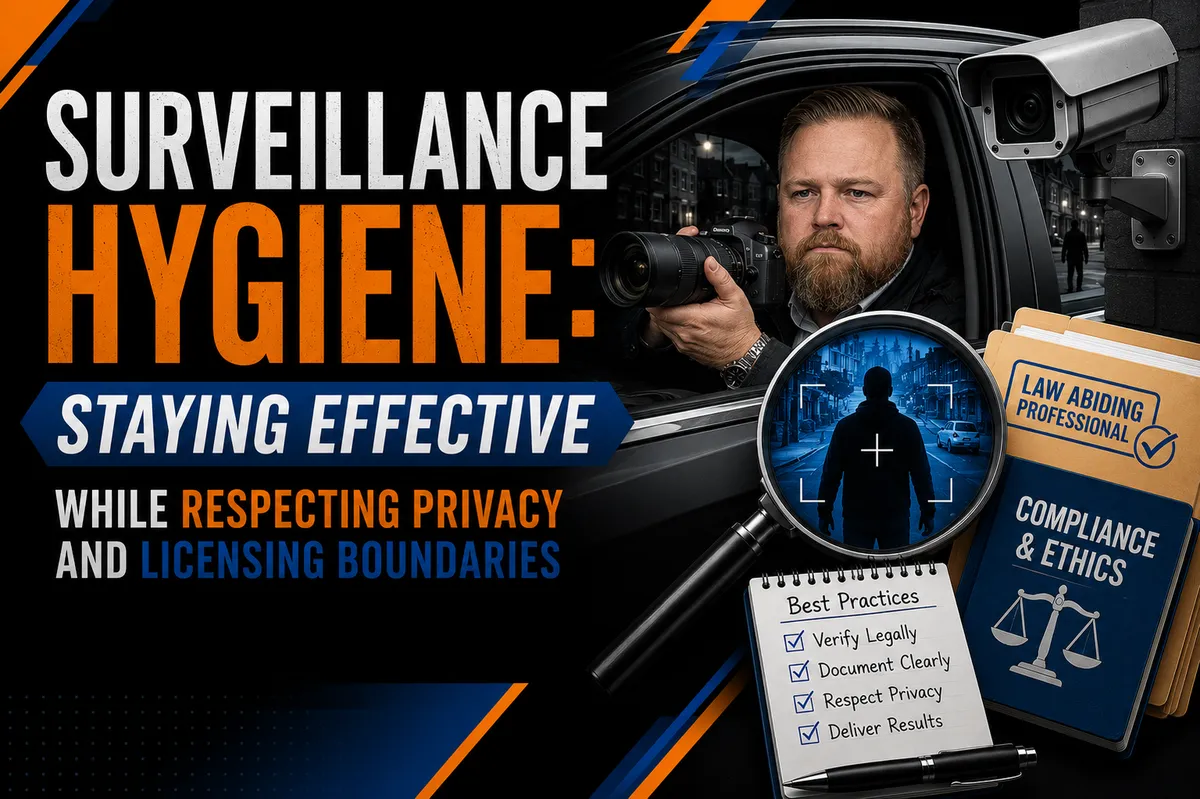
Surveillance Hygiene: Privacy, Licensing, and Compliance Best Practices for Investigators
Private investigators, process servers, and legal support professionals operate in an environment where investigative effectiveness and legal compliance must work together. Clients want useful intelligence and reliable evidence, but the methods used to obtain that information may eventually face scrutiny from attorneys, courts, regulators, insurers, or opposing parties.
That is why surveillance hygiene should be a core part of every professional investigative workflow.
Surveillance hygiene means using disciplined procedures to conduct surveillance lawfully, document observations accurately, protect sensitive information, and stay within applicable privacy and licensing boundaries. Done well, these practices reduce risk while producing stronger, more defensible investigative work.
For private investigators and process servers, good surveillance hygiene is not simply about avoiding problems. It can become a competitive advantage with law firms, insurance carriers, corporate clients, and other organizations that value professional, well-documented investigations.
What Is Surveillance Hygiene?
Surveillance hygiene is the collection of policies, procedures, and everyday habits used to keep investigative surveillance lawful, ethical, secure, and professionally defensible.
A strong surveillance hygiene program typically addresses:
Privacy and lawful observation
Private investigator licensing requirements
Jurisdictional restrictions
Objective surveillance reporting
Evidence handling
Data security and retention
Appropriate use of investigative technology
Client authorization and assignment scope
The objective is straightforward: obtain relevant information without creating unnecessary legal, ethical, or evidentiary risk.
Surveillance hygiene therefore starts before an investigator enters the field and continues through evidence storage, reporting, and final case disposition.
Why Surveillance Compliance Matters
Surveillance can produce valuable evidence, but the value of that evidence depends partly on how it was obtained and documented.
Investigators should consider applicable laws and rules involving privacy, licensing, recording, data protection, and investigative conduct before beginning an assignment.
Depending on the jurisdiction and circumstances, relevant considerations may include:
State private investigator licensing laws
State privacy statutes
Audio and video recording laws
Trespass and property-access restrictions
Data protection requirements
Client authorization and permissible purpose
Rules governing investigative databases
Interstate licensing or reciprocity requirements
Because these requirements vary significantly by jurisdiction, investigators should avoid assuming that a technique permitted in one state is automatically permissible in another.
A repeatable surveillance compliance checklist can help identify potential issues before they become field problems.
Private Investigator Licensing Requirements: Know Your Scope
Licensing is one of the most important boundaries in professional investigative work.
Understand What Your License Authorizes
Private investigator licensing requirements vary by state and sometimes by the type of investigative activity being performed.
Before accepting an assignment, investigators should understand questions such as:
Is a private investigator license required for this activity?
Does my current license cover the work being requested?
Are particular investigative techniques restricted?
Are additional registrations, permits, or certifications required?
What records must be maintained?
Are there specific reporting or retention requirements?
Understanding the scope of your authority helps reduce regulatory exposure and prevents an otherwise useful investigation from being undermined by a licensing problem.
Be Careful With Multi-State Surveillance
Licensing becomes especially important when a subject, client, or investigation crosses state lines.
Before conducting investigative activity in another jurisdiction, determine whether the assignment creates additional requirements involving:
License reciprocity
Temporary practice
Local licensing
Agency registration
Subcontracting to an appropriately licensed investigator
Recordkeeping
Reporting obligations
Do not assume your home-state license automatically authorizes investigative activity elsewhere.
For firms handling nationwide assignments, a jurisdiction-by-jurisdiction compliance procedure can be particularly valuable.
Privacy Boundaries in Surveillance and Process Serving
Privacy is another essential component of ethical surveillance practices.
The fact that information may be useful to an investigation does not necessarily mean every method of obtaining it is appropriate.
Investigators and process servers should focus on information that is relevant to a legitimate assignment while avoiding unnecessary intrusion.
Public Observation vs. Private Spaces
A fundamental surveillance question is whether the activity being observed occurs where the subject has a reasonable expectation of privacy.
Investigators should understand applicable laws before photographing, recording, or monitoring individuals, particularly when activity involves private property or spaces not readily observable by the public.
Professional surveillance should avoid conduct that could create allegations of:
Trespassing
Harassment
Stalking
Improper recording
Unlawful access
Excessive or unjustified monitoring
When the legal boundary is uncertain, obtaining jurisdiction-specific legal guidance is preferable to improvising in the field.
Process Server Privacy Considerations
Process servers sometimes conduct limited investigative work to confirm an address, identify a vehicle, locate a subject, or determine whether an individual is likely to be present at a particular location.
Those activities can create their own process server privacy considerations.
A good rule of operational discipline is to collect what is reasonably necessary for the assignment rather than gathering personal information simply because it is available.
For example, a process server trying to verify whether a defendant resides at an address may need information related to residency or identity. Unrelated details about neighbors, family members, or personal activities may add little value while increasing privacy and data-security exposure.
This principle of data minimization can improve both compliance and operational efficiency.
Ethical Surveillance Practices Start With Planning
Effective surveillance does not require unnecessarily aggressive tactics. In many cases, planning produces better results.
Before beginning surveillance, consider documenting:
The legitimate purpose of the assignment
The client's instructions and authorization
Relevant licensing requirements
Jurisdiction-specific privacy or recording restrictions
Appropriate observation locations
Evidence and reporting requirements
Data-security procedures
Conditions that would require the investigator to disengage or reassess
This pre-surveillance compliance review can help prevent investigators from making important legal or operational decisions under pressure in the field.
Effective Surveillance Techniques That Respect Legal Boundaries
Professional surveillance generally emphasizes patience, verification, and accurate documentation.
Depending on the assignment and applicable law, effective surveillance techniques may include:
Selecting lawful observation points
Documenting dates and times accurately
Recording objective observations
Conducting appropriate public-record research
Using lawful open-source intelligence
Capturing permissible photographic or video evidence
Verifying relevant locations
Maintaining chronological activity logs
The objective is not to collect the maximum possible amount of information.
It is to collect the right information using defensible methods.
Investigative Documentation: Separate Facts From Conclusions
Strong documentation is one of the most important elements of professional surveillance.
A surveillance report should allow another person to understand what the investigator actually observed without requiring speculation.
Useful investigative records may include:
Date
Start and end times
Relevant locations
Weather or visibility conditions when material
Objective observations
Vehicle descriptions when relevant
Photographs or video references
Significant movements or activities
Investigative actions taken
Gaps or interruptions in surveillance
Objective Reporting Matters
Investigators should distinguish between observation and interpretation.
Objective observation:
"The individual entered the blue sedan at approximately 8:15 a.m. and drove away from the residence."
Potentially speculative interpretation:
"The individual left the residence to go to work."
Unless the destination or purpose is independently established, the second statement introduces an assumption.
This distinction matters because surveillance reports may later be reviewed by attorneys, claims professionals, courts, or opposing experts.
Objective language strengthens credibility.
Maintain a Clear Evidence Trail
Surveillance evidence should also be organized so that its origin and handling can be explained.
Depending on the nature of the case, firms may want procedures for documenting:
When evidence was captured
Who captured it
Which case it belongs to
Where the original file is stored
Whether a working copy was created
Who had access
Whether the file was transferred
When the evidence was archived or deleted
Maintaining a clear evidence trail can improve internal quality control and make the final investigative work product easier to defend.
Data Security Is Part of Surveillance Compliance
Private investigators and process servers may collect highly sensitive information during an assignment.
This can include:
Photographs and video
Names and personal identifiers
Addresses
Vehicle information
Location information
Case documents
Client communications
Investigative research
Protecting that information should be part of the firm's broader surveillance compliance program.
Data Security Best Practices for Investigators
Depending on the firm's needs and applicable requirements, safeguards may include:
Encryption
Strong authentication
Role-based access controls
Secure file-transfer systems
Device security
Evidence backups
Audit logs
Written retention schedules
Secure deletion procedures
Access should generally be limited to people with a legitimate business need for the information.
Investigators should also consider how long information actually needs to be retained. Keeping unnecessary sensitive data indefinitely can create additional exposure without providing meaningful investigative value.
Using Surveillance Technology Responsibly
Modern technology can make investigative work significantly more efficient.
Common technologies used by private investigators and process-serving organizations include:
Digital case management systems
Mobile reporting applications
GPS-enabled documentation tools
Secure evidence repositories
Public-record databases
Open-source research tools
Time-stamped digital logs
Automated reporting systems
Technology, however, does not override legal boundaries.
Before deploying a new investigative tool, firms should ask:
What information does the tool collect?
Where does the information come from?
Is its use permitted for this assignment?
Are there contractual restrictions?
Who can access the resulting data?
How long is the information stored?
Can the information be independently verified?
How would we explain the use of this tool if challenged?
The most sophisticated technology is not necessarily the safest or most useful option. A tool should support a lawful investigative process rather than replace professional judgment.
Surveillance Tools for Process Servers
Process servers who perform investigative or location-verification work may benefit from tools that strengthen documentation rather than encourage unnecessary surveillance.
Useful categories include:
Process serving case management software
Secure cloud storage
GPS-enabled attempt documentation
Mobile field reporting
Evidence management systems
Address research tools
Public-record resources
Platforms such as ServeManager, Crosstrax, and other case-management solutions may support portions of these workflows depending on a firm's requirements.
The specific platform matters less than having a consistent process for collecting, reviewing, protecting, and reporting information.
Process Serving Compliance and Surveillance Hygiene
For process-serving firms, surveillance hygiene can fit within a broader process serving compliance program.
Strong compliance procedures can help organizations:
Reduce avoidable legal risk
Improve service-attempt documentation
Produce more consistent reports
Protect sensitive case information
Strengthen client confidence
Improve quality control
Support defensible affidavits and service records
Protect professional reputation
This is especially important when investigative research supports an eventual service attempt.
If the underlying research is inaccurate, poorly documented, or obtained through questionable methods, the resulting service decision may also become harder to defend.
A Practical Surveillance Hygiene Checklist
Before, during, and after a surveillance assignment, investigators can use a simple checklist to reinforce good habits.
Before Surveillance
Confirm the assignment's legitimate purpose.
Verify client instructions and authority.
Confirm applicable licensing requirements.
Review jurisdiction-specific restrictions.
Identify lawful observation strategies.
Review recording and privacy considerations.
Establish reporting requirements.
Confirm secure evidence-storage procedures.
During Surveillance
Remain within authorized scope.
Use lawful observation locations.
Keep accurate chronological notes.
Separate observations from assumptions.
Capture only relevant information.
Avoid unnecessary interaction or escalation.
Follow established evidence-handling procedures.
After Surveillance
Complete the report promptly.
Review notes for accuracy.
Label and organize supporting evidence.
Transfer files securely.
Restrict access to authorized personnel.
Apply applicable retention requirements.
Document unusual incidents or compliance concerns.
A short checklist performed consistently can prevent small mistakes from becoming significant problems.
Common Surveillance Hygiene Mistakes to Avoid
Even experienced investigators can create unnecessary risk when procedures become informal.
Common mistakes include:
Assuming licensing rules are the same across jurisdictions
Collecting more personal information than the assignment requires
Mixing observations with unsupported conclusions
Using insecure consumer messaging or file-sharing methods for sensitive evidence
Failing to document when and where evidence was obtained
Retaining sensitive information without a clear purpose
Using new surveillance technology without reviewing its legal implications
Allowing client pressure to override professional or legal boundaries
Standardized procedures help reduce these risks and create more consistent work across an investigative team.
Why Surveillance Hygiene Is a Competitive Advantage
Clients do not simply purchase surveillance hours. They purchase reliable information they can use.
For law firms, insurance carriers, corporations, and other sophisticated clients, an investigative report is more valuable when the underlying methods are professional and defensible.
Strong surveillance hygiene demonstrates that a firm takes seriously:
Privacy
Licensing
Evidence integrity
Data security
Accurate reporting
Professional ethics
Regulatory compliance
That reputation can become a meaningful differentiator when clients compare investigative providers.
The strongest firm is not necessarily the one willing to use the most aggressive techniques. Often, it is the firm capable of producing useful results while maintaining clean, documented, and defensible methods.
The Future of Ethical Surveillance and Investigative Compliance
Privacy regulation, digital evidence standards, and investigative technology will continue to evolve.
Artificial intelligence, advanced databases, automated identification systems, location data, and increasingly powerful research tools may give investigators access to more information than ever before.
That makes professional restraint and compliance even more important.
Successful investigative organizations will need procedures for evaluating not only whether a technology can obtain information, but whether the information should be collected, how it may lawfully be used, and how it should be protected.
Firms that develop those habits now will be better prepared as regulatory expectations change.
Conclusion: Better Surveillance Starts With Better Processes
Surveillance hygiene is more than a compliance concept. It is a professional discipline that protects investigators, clients, subjects, and the integrity of investigative work.
Private investigators and process servers can strengthen their operations by understanding licensing boundaries, respecting privacy rights, documenting observations objectively, protecting sensitive information, and evaluating investigative technology carefully.
Effective surveillance is not measured simply by how much information an investigator collects.
It is measured by whether the information is relevant, reliable, lawfully obtained, securely handled, and capable of withstanding scrutiny.
In investigative work that may ultimately become part of litigation, insurance claims, or regulatory proceedings, clean methods create stronger evidence—and stronger businesses.
Disclaimer: This article provides general educational information and is not legal advice. Surveillance, privacy, recording, licensing, and investigative laws vary by jurisdiction. Investigators and process-serving firms should consult applicable laws, licensing authorities, and qualified legal counsel regarding specific assignments.
About Mighty Process Server
Mighty Process Server (MPS) supports process servers, investigators, attorneys, law firms, and legal professionals through education, operational guidance, and industry best practices. By promoting ethical documentation, compliance-focused workflows, and professional standards, MPS helps legal service providers create defensible work product that stands up to scrutiny while supporting long-term business growth.
Stay sharp. Stay informed. Live Mighty!
Read the full article at www.mightyprocessserver.com
This article is published by Process Server Daily, powered by MightyAutomation.ai, the leader in legal support intelligence.