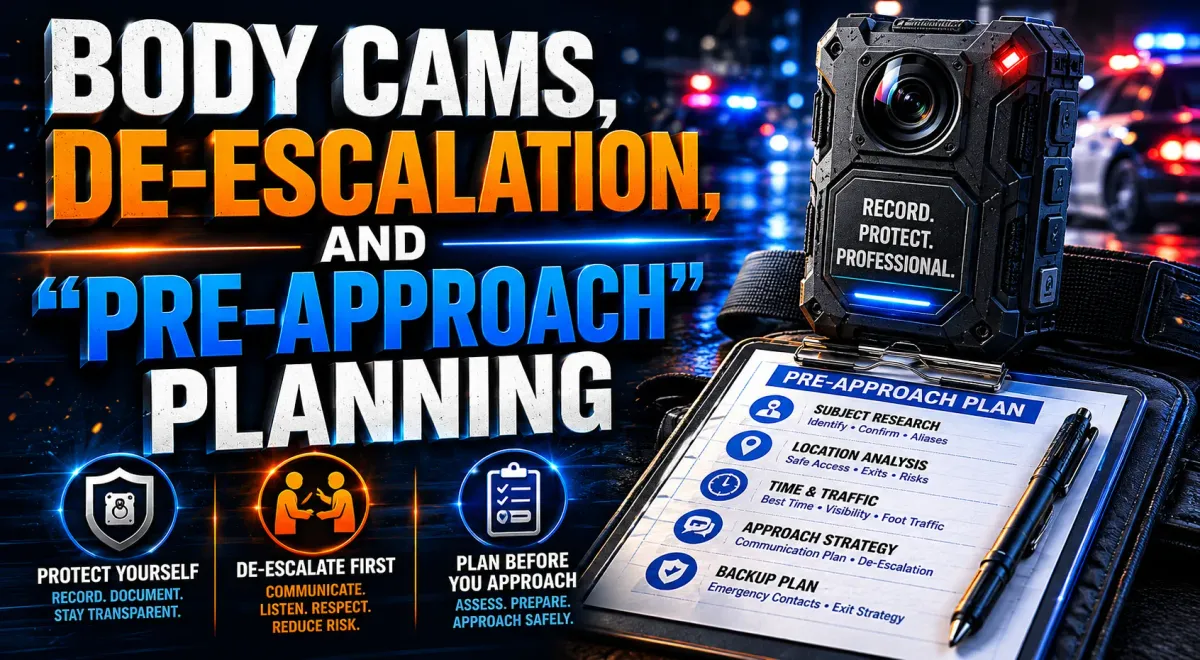
Body Cams, De-Escalation, and Pre-Approach Planning: Process Server Safety Best Practices
Process serving can become unpredictable quickly. A routine service attempt may involve a recipient dealing with a lawsuit, financial pressure, family conflict, an eviction, or another stressful legal matter. Even when a process server approaches professionally, the person receiving the documents may react with confusion, anger, fear, or hostility.
That is why process server safety should be treated as an operational system rather than an afterthought.
A strong safety strategy combines pre-approach planning, de-escalation techniques, body cameras, accurate documentation, and clear disengagement procedures. Together, these practices can help process servers reduce unnecessary risk while creating more credible and defensible records of what occurred in the field.
This guide examines how body cams, communication techniques, and pre-approach planning can work together to create a practical safety stack for modern process servers.
Why Process Server Safety Requires a Proactive Approach
Every service attempt contains some degree of uncertainty.
Process servers regularly visit unfamiliar residences, workplaces, businesses, apartment complexes, and other locations where they may have limited information about the recipient or surrounding environment.
Recipients may:
Be surprised by the visit
Misunderstand why the process server is there
Become emotionally upset
Refuse to cooperate
Attempt to evade service
Become verbally confrontational
Create conditions that make completing the attempt unsafe
The objective is not simply to deliver legal documents. Professional process serving also requires good judgment about when to approach, how to communicate, what to document, and when to disengage.
Building those decisions into a repeatable process can improve both safety and consistency.
What Is Pre-Approach Planning for Process Servers?
Pre-approach planning for process servers is the process of reviewing available information and assessing potential risks before initiating contact with a recipient.
Instead of arriving at an address and immediately walking to the door, the server takes a moment to understand the assignment and surrounding environment.
Even a brief assessment can identify information that changes how an attempt should be handled.
1. Verify the Assignment Before Arrival
Before approaching a location, review the information associated with the assignment.
Depending on the case and information lawfully available, this may include:
Recipient's full name
Known name variations or aliases
Current service address
Physical description, when available
Special client instructions
Previous service attempts
Known access restrictions
Relevant safety information
Accurate information helps prevent mistaken identity, unnecessary confrontations, and wasted attempts.
It also supports more accurate field documentation.
2. Assess the Environment Before Approaching
Once at the location, observe the environment before making contact.
Consider factors such as:
Lighting and visibility
Safe and lawful parking
Building access
Potential exit routes
Aggressive or unsecured animals
Groups of people near the entrance
Signs of an active confrontation
Other conditions that could affect safety
Situational awareness does not require assuming that every location is dangerous. It means recognizing environmental factors before they become problems.
3. Know When Not to Approach
One of the most important process server safety tips is knowing when an attempt should be postponed.
Conditions that may justify reassessing an approach can include apparent violence, active fighting, threatening behavior, aggressive animals, or other immediate hazards.
Completing a service attempt is important, but no individual attempt is worth ignoring a credible safety concern.
A process server should follow applicable law, client requirements, and company policies when deciding whether to disengage and return at another time.
Body Cams for Process Servers: Safety and Documentation Benefits
Body cams for process servers are increasingly discussed as tools for both safety and documentation.
Although body-worn cameras are widely associated with law enforcement, the underlying technology can also be useful in certain private-sector field operations when recording is lawful and appropriate.
For process servers, a body camera may create an objective record of an interaction that would otherwise depend primarily on memory and written notes.
Potential Body Cam Benefits for Process Servers
Depending on applicable laws and company policies, body-worn cameras may help provide:
A contemporaneous record of an interaction
Visual documentation of the circumstances surrounding an attempt
Support for accurate field notes and reports
Evidence relevant to disputed interactions
Additional context when allegations arise
Documentation for internal incident review
A recording should not replace good written documentation. Instead, it may complement field notes, GPS records, timestamps, photographs when permitted, and other documentation maintained during the assignment.
How Body Cameras Can Support Defensible Service Records
Service disputes can involve conflicting accounts of what occurred.
Questions may arise about:
Who answered the door
What the recipient said
Whether an interaction became hostile
Where the process server was standing
How the process server conducted the interaction
What circumstances surrounded a particular attempt
When legally obtained and properly preserved, video footage may provide additional context.
This can be particularly useful when preparing reports, responding to client questions, reviewing incidents, or addressing allegations concerning a service attempt.
However, footage should never be treated as automatically conclusive. Its usefulness will depend on factors such as recording quality, completeness, authenticity, applicable evidentiary rules, and the circumstances of the case.
De-Escalation Techniques for Process Servers
Technology cannot replace professional communication.
In many field encounters, a process server's ability to remain calm and communicate clearly can significantly influence how an interaction develops.
Effective de-escalation techniques for process servers focus on reducing unnecessary tension while maintaining professional boundaries.
Stay Calm and Professional
A calm tone and controlled demeanor can help prevent an emotionally charged interaction from escalating.
Avoid matching a recipient's anger or raising your voice simply because the other person does.
Professionalism is especially important when an interaction may later be described in an affidavit, report, complaint, or court proceeding.
Keep Communication Simple
Legal disputes are complicated. The interaction at the door usually does not need to be.
Use clear, concise language and avoid unnecessary legal explanations or arguments.
A process server's role generally is not to provide legal advice or debate the merits of the underlying case.
Practice Active Listening
Sometimes allowing a person to briefly express frustration can reduce tension.
Active listening does not mean agreeing with the recipient or becoming involved in the dispute. It means hearing what the person is saying while maintaining appropriate professional boundaries.
Maintain Physical Space
Avoid unnecessarily crowding a recipient or blocking movement.
Maintaining appropriate distance can help reduce perceived confrontation while giving the server additional space to respond if conditions change.
Do Not Argue About the Case
One of the simplest rules for field work is:
You do not win arguments on the porch.
A process server does not need to convince the recipient that the lawsuit is justified, explain the client's position, or resolve the underlying legal dispute.
The objective is to complete lawful service when possible and accurately document what happened.
Recognize When to Disengage
De-escalation does not mean remaining in an unsafe situation indefinitely.
If an interaction progresses from frustration to credible threats, violence, or another immediate safety risk, disengagement may be the appropriate response.
Process servers should understand their organization's escalation and incident-reporting procedures before entering the field.
Body Cam Laws and Privacy Considerations
Body cameras can create valuable records, but recording also creates legal and privacy obligations.
Body cam laws for process servers can vary significantly by jurisdiction, particularly when audio is recorded.
Depending on the location and circumstances, relevant laws may address:
Consent to audio recording
Recording conversations
Reasonable expectations of privacy
Recording on private property
Data storage and security
Access to recordings
Evidence preservation
Retention and deletion policies
Process servers should not assume that because a camera can record an interaction, recording is automatically lawful.
Audio Recording Deserves Particular Attention
Audio recording laws can differ substantially among jurisdictions.
The legality of recording may depend on where the interaction occurs, whether the conversation is considered private, who is participating, and other circumstances.
Businesses considering body-worn cameras should obtain appropriate guidance regarding the jurisdictions in which their servers operate.
Create a Written Body Camera Policy
Organizations using body cameras should consider written policies addressing questions such as:
When should recording begin?
When should recording stop?
When is recording prohibited?
Should audio be enabled?
Where will footage be stored?
Who can access recordings?
How long will recordings be retained?
How will footage connected to an incident or dispute be preserved?
How will sensitive information be protected?
How will requests for footage be handled?
Without consistent policies, body cameras can create new compliance and privacy risks instead of reducing them.
Protecting Body Cam Footage and Client Information
A body camera is also a data-collection device.
Recordings may capture names, addresses, faces, conversations, documents, vehicle information, interiors of properties, or other sensitive information.
That makes data security an important component of process server safety technology.
Organizations should consider appropriate controls for:
Secure storage
Account access
Device security
File transfers
Retention schedules
Authorized viewing
Evidence preservation
Secure deletion
The goal should be to collect only what is appropriate and then protect that information throughout its lifecycle.
Essential Process Server Safety Equipment
Body cameras are only one component of a broader safety program.
Depending on the assignment, jurisdiction, and company policies, process server safety equipment may include:
Body-worn cameras
Charged mobile phones
GPS-enabled devices
Flashlights
Personal safety alarms
Vehicle dash cameras
Portable battery packs
Appropriate identification or credentials
Equipment should support professional operations rather than create a false sense of security.
Technology is most effective when paired with training, situational awareness, and clear procedures.
Build a Process Server Safety Stack
Instead of viewing safety tools independently, agencies can organize them into a simple operational framework.
Layer 1: Pre-Approach Planning
Before contact:
Verify assignment information
Review previous attempts
Understand special instructions
Assess known risks
Observe the location
Layer 2: Situational Awareness
At the location:
Maintain awareness of surroundings
Identify safe movement and exit options
Observe environmental hazards
Reassess conditions as they change
Layer 3: Professional Communication
During contact:
Remain calm
Use concise language
Maintain appropriate distance
Avoid unnecessary arguments
Recognize signs of escalation
Layer 4: Documentation
After the interaction:
Record accurate timestamps
Write detailed field notes
Document unusual circumstances
Preserve authorized recordings appropriately
Follow client and company reporting requirements
Layer 5: Incident Response
When something goes wrong:
Disengage when necessary
Follow established safety procedures
Contact emergency services or law enforcement when appropriate
Document threats or incidents promptly
Preserve relevant records
Notify supervisors or clients according to policy
Together, these layers create a repeatable process server safety plan rather than relying solely on instinct.
Why Detailed Field Notes Still Matter
Even when a process server uses body cameras, GPS data, mobile applications, and other technology, traditional field notes remain important.
A strong service record may document:
Date and time
Address
Description of the location
Person contacted
Relevant statements
Description of the recipient when appropriate
Service outcome
Unusual circumstances
Safety concerns
Follow-up actions
Notes should be made as close to the event as practical while details remain fresh.
Technology can strengthen documentation, but disciplined recordkeeping remains one of the most important process server best practices.
Creating Internal Process Server Safety Policies
Agencies should consider establishing written safety procedures instead of leaving every decision entirely to individual judgment.
Policies may address:
Pre-approach risk assessment
Body camera usage
De-escalation procedures
Disengagement criteria
Threat reporting
Incident documentation
Law enforcement contact procedures
Evidence preservation
Check-in procedures
High-risk assignments
Data privacy and retention
Consistent procedures can help servers make better decisions under pressure and create more uniform documentation across an organization.
Common Process Serving Challenges and How Preparation Helps
A structured safety system can help professionals respond more consistently to common field challenges.
Evasive Recipients
Accurate assignment information and detailed documentation can help distinguish unsuccessful attempts from situations requiring further investigation or another service strategy.
Hostile Reactions
De-escalation training can help servers avoid turning frustration into confrontation while recognizing when disengagement is necessary.
Incorrect Addresses
Pre-service research and address verification can reduce unnecessary contact with uninvolved third parties.
Workplace Service
Planning ahead can help process servers understand access restrictions, security procedures, and appropriate approaches to workplace environments.
Disputed Service Attempts
Detailed notes, timestamps, photographs when permitted, GPS information, and lawful video recordings may provide additional evidence concerning what occurred.
Process Server Best Practices for Safety and Credibility
A strong safety culture does not depend on a single device or technique.
Effective process server best practices include:
Verify information before approaching
Assess the environment before initiating contact
Maintain professional communication
Use de-escalation techniques when appropriate
Avoid unnecessary arguments
Know when to disengage
Document attempts promptly and accurately
Understand local recording and privacy laws
Protect body camera footage and other sensitive data
Follow consistent incident-reporting procedures
Review safety policies regularly
Continue professional training
These practices can protect the process server while also improving the reliability and credibility of the service operation.
Frequently Asked Questions About Process Server Safety
Should process servers wear body cameras?
Body cameras may be useful for documenting interactions and supporting incident review, but whether a process server should use one depends on applicable recording laws, privacy requirements, client expectations, and company policies.
Can process servers legally record people?
Recording laws vary by jurisdiction and circumstances. Audio recording can raise additional consent and privacy issues. Process servers should understand the laws applicable where they operate before recording interactions.
What are the best de-escalation techniques for process servers?
Useful techniques include maintaining a calm tone, using simple language, keeping appropriate physical distance, actively listening, avoiding arguments about the underlying case, and disengaging when an interaction becomes unsafe.
What should a process server check before approaching a residence?
Pre-approach planning may include verifying the recipient and address, reviewing service instructions and previous attempts, observing the property and surroundings, identifying potential hazards, and considering safe exit options.
What safety equipment should a process server carry?
Depending on local laws and company policies, useful equipment may include a charged phone, flashlight, GPS-enabled device, personal safety alarm, body camera, dash camera, and portable battery pack.
Does body camera footage replace process server field notes?
No. Video footage can supplement documentation, but detailed contemporaneous field notes remain important for accurately recording service attempts and unusual circumstances.
Final Thoughts: Make Process Server Safety a Repeatable System
Process server safety is strongest when preparation, communication, technology, and documentation work together.
Body cameras can provide useful records. De-escalation techniques can reduce unnecessary confrontation. Pre-approach planning can help process servers identify risks before making contact. Detailed field notes and clear internal procedures can strengthen the defensibility of every attempt.
No individual tool eliminates risk.
The better approach is to build a repeatable safety stack:
Plan before approaching. Stay aware. Communicate professionally. Document accurately. Disengage when necessary.
For process serving agencies, investing in these practices can do more than improve field safety. It can strengthen documentation, reduce operational risk, improve client confidence, and support the professional credibility of every service attempt.
About Mighty Process Server
Mighty Process Server (MPS) supports process servers, attorneys, law firms, and legal professionals through education, operational guidance, and technology-focused best practices. Platforms such as MightyProcessServer.com help standardize documentation, reporting, timestamps, notes, and supporting evidence, creating consistent records that strengthen both safety and credibility in the field.
Stay sharp. Stay informed. Live Mighty!
Read the full article at www.mightyprocessserver.com
This article is published by Process Server Daily, powered by MightyAutomation.ai, the leader in legal support intelligence.