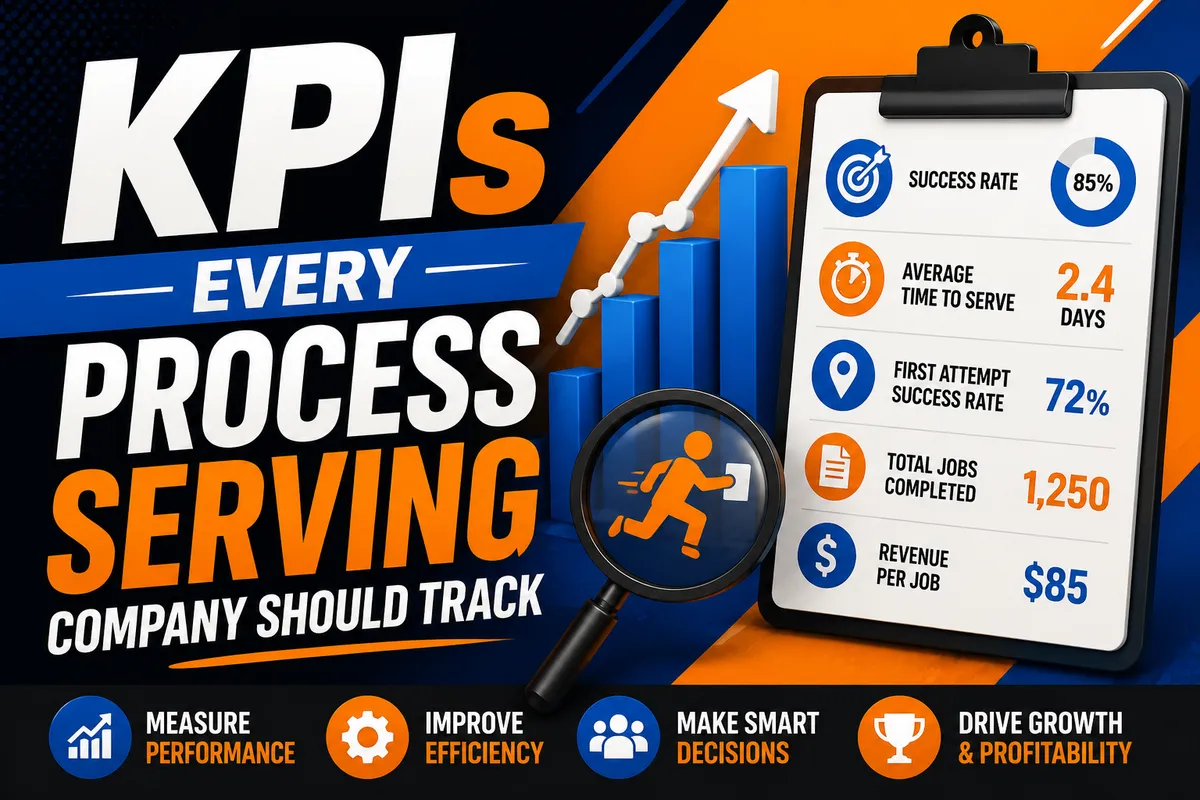
KPIs Every Process Serving Company Should Track
Introduction to KPIs for Process Serving Companies
Success in the process serving industry depends on more than simply delivering legal documents. Every successful company needs to understand how efficiently it operates, how satisfied its clients are, and where improvements can be made. This is where process serving KPIs, or Key Performance Indicators, become essential.
KPIs are measurable values that help businesses evaluate performance against specific goals. For process serving companies, these metrics provide valuable insights into service quality, operational efficiency, financial health, and customer satisfaction. Instead of relying on assumptions, owners and managers can use real data to make informed decisions that improve daily operations and support long-term growth.
Whether you operate as an independent process server or manage a nationwide agency, tracking the right KPIs can help increase productivity, reduce costs, strengthen client relationships, and improve overall business performance.
Why Tracking KPIs Is Essential for Process Servers
Monitoring key performance indicators for process servers provides a clear understanding of how well the business is performing.
By consistently measuring performance, companies can:
Identify operational inefficiencies
Improve service quality
Increase accountability
Monitor employee productivity
Reduce unnecessary expenses
Improve communication
Strengthen client relationships
Support strategic business decisions
Increase profitability
In an industry where speed, accuracy, and professionalism are critical, KPI tracking helps companies maintain high standards while remaining competitive.
What Are KPIs?
A Key Performance Indicator is a measurable metric that evaluates how effectively a business achieves its objectives.
For process serving companies, KPIs measure important aspects such as:
Service completion
Turnaround time
Client satisfaction
Revenue
Expenses
Employee productivity
Business growth
Tracking these process server metrics regularly allows managers to identify trends, solve problems early, and continuously improve operations.
1. Service Completion Rate
One of the most important process server performance metrics is the percentage of assignments successfully completed.
Formula:
Service Completion Rate = (Completed Serves ÷ Total Assignments) × 100
A consistently high completion rate demonstrates reliability, effective planning, and strong field performance.
Monitoring this KPI also helps identify assignments that require additional investigative work or operational improvements.
2. Average Time to Serve
Clients expect prompt service.
This KPI measures the average amount of time between receiving an assignment and successfully serving the legal documents.
Tracking turnaround time helps companies:
Improve scheduling
Reduce delays
Increase client satisfaction
Meet court deadlines
Improve operational planning
Faster service often becomes a significant competitive advantage.
3. First Attempt Success Rate
A successful serve during the first visit saves time, fuel, and labor costs.
This KPI measures how often legal documents are served during the initial attempt.
Improving first-attempt success often results from:
Better address verification
Effective skip tracing
Accurate client information
Efficient route planning
Experienced field professionals
A high first-attempt success rate directly improves efficiency in process serving.
4. Client Satisfaction Score
Client satisfaction remains one of the strongest indicators of business success.
Companies can measure satisfaction through:
Online reviews
Customer surveys
Follow-up emails
Direct client feedback
Referral rates
Satisfied clients are more likely to submit repeat assignments and recommend your services to others.
5. Cost Per Serve
Every completed assignment has operating expenses.
Tracking the average cost per serve helps companies understand profitability while identifying opportunities to reduce unnecessary spending.
Expenses may include:
Employee wages
Fuel
Vehicle maintenance
Printing
Administrative labor
Software subscriptions
Office expenses
Lower costs combined with excellent service contribute to stronger profit margins.
6. Revenue Per Assignment
Revenue per assignment measures the average income generated from each completed job.
Formula:
Revenue Per Assignment = Total Revenue ÷ Completed Assignments
This KPI helps evaluate:
Pricing strategies
Service profitability
Premium service adoption
Revenue trends
Understanding average revenue supports smarter pricing decisions.
7. Profit Margin
Revenue alone does not determine business success.
Tracking profit margins provides a more complete picture of financial performance by comparing total income with operating expenses.
Healthy profit margins allow businesses to:
Invest in technology
Hire additional staff
Expand service areas
Improve marketing efforts
Support sustainable growth
8. On-Time Service Rate
Many legal assignments involve strict deadlines.
This KPI measures how often assignments are completed before the required due date.
Maintaining a high on-time completion rate demonstrates professionalism while building trust with law firms and legal support companies.
9. Average Number of Service Attempts
Not every assignment can be completed immediately.
Monitoring the average number of attempts required before successful service helps identify operational challenges.
Higher-than-average attempts may indicate:
Incorrect addresses
Poor scheduling
Limited skip tracing
Incomplete client information
Reducing unnecessary attempts lowers operating costs while increasing efficiency.
10. Skip Trace Success Rate
Skip tracing plays an important role in difficult assignments.
Measure:
Successful address discoveries
Time spent locating recipients
Skip trace costs
Percentage of successful locates
Improving skip trace performance supports higher service completion rates and improved client satisfaction.
11. Employee Productivity
Companies with multiple process servers should monitor individual productivity.
Useful metrics include:
Jobs completed per server
Successful serves
Average daily assignments
Documentation completion
Travel efficiency
Client feedback
These process server success metrics help identify training opportunities while recognizing top performers.
12. Dispatch Efficiency
Efficient dispatching reduces travel time while improving resource allocation.
Track:
Jobs assigned per server
Daily workload distribution
Travel distance
Route optimization
Idle time
Modern dispatch software significantly improves operational performance.
13. Affidavit Turnaround Time
Many law firms expect affidavits shortly after service is completed.
Track the average time required to:
Prepare affidavits
Review documentation
Submit completed paperwork
Faster affidavit delivery improves client satisfaction while reducing administrative delays.
14. Invoice Collection Time
Healthy cash flow is essential.
Measure how quickly invoices are paid after being issued.
Reducing payment delays improves financial stability while supporting future business growth.
15. Client Retention Rate
Returning clients often represent the most valuable source of long-term revenue.
Track how many clients continue using your services over time.
Strong client retention usually reflects:
Reliable communication
Consistent service quality
Professional documentation
Positive customer experiences
16. New Client Acquisition
Business growth depends on attracting new customers.
Monitor new clients from:
Law firms
Collection agencies
Property management companies
Government agencies
Businesses
Individual clients
Tracking acquisition sources also helps improve marketing strategies.
How to Implement KPI Tracking in Your Business
Successful KPI tracking for process servers begins with identifying the metrics most relevant to your business goals.
A practical implementation strategy includes:
Defining measurable objectives
Selecting meaningful KPIs
Setting realistic performance targets
Collecting accurate operational data
Reviewing reports regularly
Adjusting workflows based on results
Involving staff in continuous improvement
Consistent measurement creates a culture focused on accountability and performance.
Tools for Tracking Process Serving Performance
Modern process serving management tools simplify KPI reporting through automation and real-time analytics.
Common solutions include:
Process Serving Software
Purpose-built platforms automatically track assignments, service attempts, GPS verification, affidavits, invoicing, and reporting.
Business Intelligence Platforms
Solutions such as Microsoft Power BI and Tableau help visualize operational trends through interactive dashboards and reports.
Customer Relationship Management Systems
CRM platforms provide insights into customer interactions, retention rates, referral sources, and communication history.
Business Dashboards
Centralized dashboards allow managers to monitor:
Active assignments
Revenue
Service completion
Team productivity
Outstanding invoices
Client activity
Performance trends
Automation significantly improves process serving analytics while reducing manual reporting.
Using KPI Data to Improve Operations
Collecting data alone is not enough.
Companies should regularly analyze KPI reports to identify opportunities for improvement.
Examples include:
Improving routes if service times increase
Enhancing skip tracing when first-attempt success declines
Adjusting staffing during busy periods
Revising pricing if profitability decreases
Improving communication if client satisfaction falls
Using performance data strategically helps improve process serving operations while supporting better business decisions.
Common Challenges in KPI Tracking
Although KPI measurement provides valuable insights, companies may encounter challenges such as:
Inaccurate data collection
Inconsistent reporting
Multiple disconnected software systems
Employee resistance to change
Poorly defined business goals
Limited reporting capabilities
Investing in reliable technology and establishing standardized reporting procedures helps overcome these challenges.
Best Practices for Long-Term Success
To maximize the value of KPIs:
Review reports consistently
Compare monthly and yearly trends
Set measurable improvement goals
Share performance results with your team
Invest in automation
Use dashboards for real-time reporting
Continuously refine business processes
Businesses that regularly monitor performance are better positioned for long-term success.
Conclusion
Tracking process serving KPIs is one of the most effective ways to improve operational performance, increase profitability, and deliver exceptional client service. By monitoring metrics such as service completion rates, average time to serve, first-attempt success, client satisfaction, employee productivity, and financial performance, process serving companies gain valuable insights that support better decision making.
Modern reporting platforms, automation, and business dashboards make it easier than ever to track process serving performance and identify opportunities for continuous improvement. Companies that embrace data-driven management are better equipped to optimize workflows, strengthen client relationships, and achieve sustainable process serving company growth.
With the right technology, strategic planning, and ongoing performance measurement, process serving businesses can stay competitive, improve operational efficiency, and build a reputation for reliability and professionalism in today's evolving legal services industry.
Stay sharp. Stay informed. Live Mighty!
Read the full article at www.mightyprocessserver.com
This article is published by Process Server Daily, powered by MightyAutomation.ai, the leader in legal support intelligence.