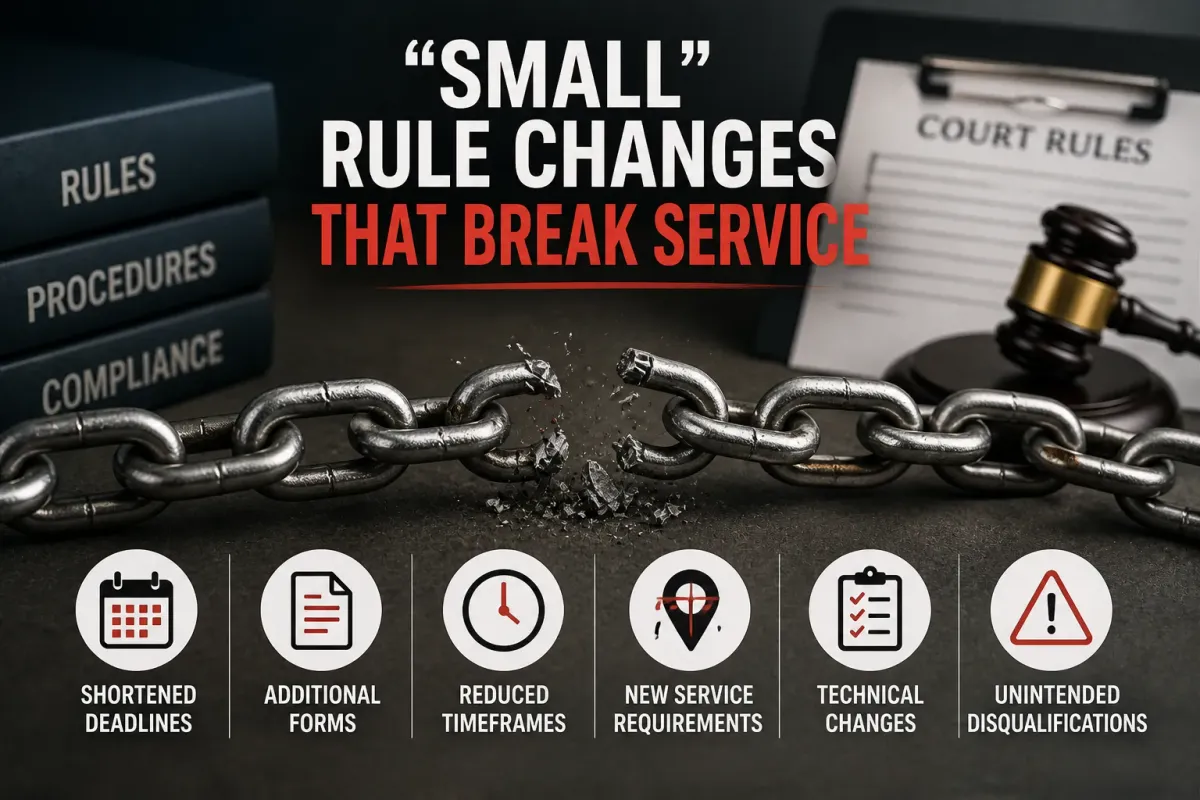
Small Process Serving Rule Changes That Can Create Big Compliance Problems
In process serving, the rule change that causes the biggest problem is not always the one that makes headlines.
A revised service window, a new affidavit requirement, a change to registered-agent availability, or a technical amendment to substitute service procedures may look minor on paper. In practice, that small change can affect whether a service attempt is valid, whether an affidavit is accepted, and whether a case moves forward without delay.
For process servers, attorneys, law firms, collection agencies, and legal support companies, staying current on process serving rule changes is an essential part of risk management. Laws and court rules governing service of process vary by jurisdiction and can change through legislation, court rules, administrative orders, and judicial decisions.
The lesson is simple: small procedural changes deserve serious operational attention.
Why Process Serving Rule Changes Matter
Service of process helps protect due process by providing legally required notice to parties involved in a case. Because valid service can affect a court's ability to proceed, compliance with applicable service rules matters at every stage.
A seemingly narrow amendment can change:
When service may be attempted
Who may accept service
Where service may occur
Which methods of service are permitted
What constitutes reasonable diligence
What information belongs in an affidavit or proof of service
How service on corporations or registered agents must be handled
When alternative or substitute service becomes available
This is why process server compliance cannot depend solely on experience. A procedure that was correct last year may not satisfy today's requirements.
The Hidden Impact of Small Process Serving Rule Changes
Major legislative reforms usually attract attention. Technical corrections and procedural amendments are easier to miss.
Yet these smaller changes can create significant operational consequences.
For example, a jurisdiction might change a registered agent's required office hours. That can affect when a process server should make an attempt and how an unsuccessful attempt should be documented.
A court might revise an affidavit requirement. The fieldwork may be performed correctly, but an outdated affidavit template could still create filing problems.
A legislature might modify substitute service requirements. A method that previously satisfied the statute may no longer be sufficient.
The impact of rule changes on process serving therefore extends beyond legal research. Changes must eventually reach dispatch instructions, field procedures, software, affidavits, training materials, and quality-control systems.
Florida's 2025 Service-of-Process Legislation: A Useful Example
Florida provides a useful illustration of how technical statutory changes can affect day-to-day process serving operations.
In 2025, Florida enacted legislation addressing service-of-process provisions following earlier statutory changes. Among the issues addressed were protections relating to service performed during a statutory transition period and requirements concerning registered-agent availability.
For process serving companies, changes involving registered offices and statutory service procedures can have practical consequences for:
Attempt scheduling
Registered-agent service
Documentation of office availability
Due diligence narratives
Affidavit preparation
Internal service instructions
The broader takeaway applies well beyond Florida: when a state changes even a narrow part of its service statute, process serving companies should determine whether their existing workflow still matches the new rule.
Because statutes and court rules can be amended again, professionals should verify the current statutory language and applicable court requirements before relying on any particular service procedure.
Common Process Serving Rule Changes That Can Affect Operations
1. Changes to Service Deadlines and Timing
Timing rules can influence everything from route planning to staffing.
Changes may involve:
Deadlines for completing service
Required intervals between attempts
Time-of-day restrictions
Notice periods
Filing deadlines
Special timelines for particular case types
A shortened deadline may require faster dispatch. A revised attempt requirement may require additional field visits. A change to permitted service hours could make an otherwise routine attempt ineffective.
For high-volume process serving companies, even a small timing change can affect hundreds or thousands of assignments.
2. Changes to Permitted Methods of Service
Courts and legislatures periodically update the ways legal documents may be served.
Depending on the jurisdiction and case type, changes may involve:
Personal service
Substitute service
Residential or abode service
Service by mail
Electronic service
Publication
Service on corporations
Service on registered agents
Court-authorized alternative service
Process servers should never assume that a method permitted in one jurisdiction—or for one type of case—is automatically valid elsewhere.
Maintaining jurisdiction-specific instructions is an important safeguard against applying the wrong legal document delivery rules to an assignment.
3. Registered Agent and Business Entity Requirements
Service on companies can become complicated when statutes change who may accept process, when registered offices must be available, or what a server must do when an agent cannot be located.
Operational questions may include:
Who is legally authorized to accept service?
What hours must the registered office maintain?
What should be documented if the office is closed?
What happens if the registered agent has moved?
When may another method of service be used?
What additional diligence must occur first?
These details can determine whether an attempt supports the next legally permitted step.
4. Due Diligence Requirements
The phrase due diligence appears frequently in process serving, but its practical meaning can vary considerably by jurisdiction and context.
A rule change may affect the number, timing, location, or nature of attempts expected before another form of service is permitted.
Strong diligence documentation may include relevant facts such as:
Date and time of each attempt
Address attempted
Observations at the property
Information received from occupants or other appropriate sources
Access restrictions
Business or registered-office conditions
Results of address verification
Other facts relevant to the service effort
The objective is not to create unnecessary detail. It is to create an accurate, contemporaneous record showing what actually occurred.
5. Affidavit and Proof-of-Service Changes
One of the easiest compliance problems to overlook is an outdated affidavit template.
A jurisdiction may change the information required in a proof or affidavit of service without substantially changing the field procedure itself.
Depending on applicable law, required information may involve:
Date and time
Location
Method of service
Recipient identity or description
Relationship to the party being served
Attempt history
Server identification or registration information
Supporting declarations or certifications
A process server can perform excellent fieldwork and still create problems if the final documentation does not satisfy current requirements.
How Small Rule Changes Turn Into Major Service Problems
The greatest risk often comes from the gap between a legal update and an operational update.
Consider a process serving company that has used the same workflow for several years. A statute changes, but the company does not immediately update its instructions.
The field server follows the old procedure.
Dispatch does not flag the issue.
The affidavit template still contains the old language.
Quality control approves the file because everything appears consistent with the company's historical practice.
The problem may not surface until an attorney reviews the service, a clerk rejects documentation, or opposing counsel challenges it.
One small rule change has now become a larger operational problem involving additional attempts, delays, expenses, or litigation over service.
Process Server Compliance: How to Respond to Rule Changes
Process serving companies need a repeatable system for converting legal developments into operational changes.
Maintain a State Law and Court Rule Watchlist
Firms operating across multiple jurisdictions should maintain a state-specific process serving laws watchlist.
Useful sources may include:
State legislature websites
State judiciary and court websites
Court rule announcements
Administrative orders
Professional process server associations
Relevant appellate decisions
Trusted legal publications
Do not rely exclusively on social media posts or secondhand summaries when making compliance decisions. Whenever possible, confirm a change through the underlying statute, rule, order, or official court source.
Review Affidavit Templates Regularly
Affidavit and proof-of-service templates should be treated as controlled operational documents rather than permanent forms.
When a rule changes, review whether templates need additional fields for matters such as:
Attempt dates and times
Registered-agent availability
Access restrictions
Recipient descriptions
Substitute service details
Due diligence efforts
Jurisdiction-specific declarations
Version control can also help prevent employees and contractors from accidentally using obsolete forms.
Train Dispatch and Administrative Staff
Compliance is not solely a field-server responsibility.
Dispatchers, intake personnel, affidavit teams, quality-control staff, and managers all influence whether an assignment follows the correct procedure.
When a legal service rule update becomes effective, internal training should explain:
What changed
When the change takes effect
Which assignments are affected
What field servers must do differently
What documentation must be collected
Whether affidavits or client instructions must change
Turning legal language into clear operational instructions reduces the likelihood that an update will be misunderstood.
Build Jurisdiction-Specific Service Instructions
Generic instructions are convenient, but service-of-process rules are highly jurisdiction-dependent.
Process serving companies operating across states, counties, or courts can benefit from maintaining jurisdiction-specific guidance covering:
Permitted service methods
Service restrictions
Registered-agent procedures
Substitute service
Due diligence expectations
Affidavit requirements
Special case categories
These instructions should be reviewed whenever the underlying law or court rule changes.
Create a Rule-Change Implementation Checklist
Finding a legal update is only the first step. Firms also need to make sure the change reaches every part of the operation.
A practical process serving compliance checklist might include:
Verify the change using an authoritative legal or court source
Record the effective date
Identify affected jurisdictions and case types
Review service instructions
Update affidavit and proof-of-service templates
Update dispatch procedures
Update software rules or automated instructions
Notify field servers and contractors
Train administrative and quality-control staff
Review assignments that cross the effective date
Document when the operational update was implemented
This creates an audit trail showing that the company did more than simply learn about the new rule—it incorporated the change into its workflow.
Technology Can Help Manage Process Serving Compliance
Process serving software can make legal updates easier to implement consistently across an organization.
Depending on the platform, firms may be able to use technology to:
Maintain jurisdiction-specific instructions
Require particular fields before an attempt can be completed
Track attempt dates and times
Store supporting documentation
Standardize affidavits
Flag missing information
Maintain historical job records
Create audit-ready service histories
Technology does not replace legal knowledge or professional judgment. Its value is in helping organizations apply established procedures consistently.
Why Compliance Can Be a Competitive Advantage
Keeping up with process serving regulations is not only about avoiding mistakes.
Law firms, attorneys, collection agencies, government entities, and corporate legal departments increasingly value service providers that can produce reliable, defensible documentation.
A company that demonstrates disciplined compliance procedures can differentiate itself through:
Accurate service records
Consistent affidavits
Faster adaptation to legal changes
Better quality control
Clearer communication
Stronger audit trails
Reduced risk of preventable service disputes
For clients managing significant litigation volume, operational reliability can matter as much as speed.
Frequently Asked Questions About Process Serving Rule Changes
How often do process serving laws change?
There is no universal schedule. Service requirements can change through legislation, amendments to court rules, administrative orders, and court decisions. Professionals should monitor the jurisdictions in which they regularly operate.
Can a small procedural change invalidate service?
Potentially. Whether a defect affects service depends on the applicable law, facts, and court. Changes involving permitted methods, authorized recipients, deadlines, or statutory prerequisites can be particularly important.
Who is responsible for monitoring process serving regulations?
Responsibilities vary by organization. Strong process serving companies typically establish a defined process for monitoring legal changes and communicating them to management, dispatch, field servers, affidavit teams, and quality-control personnel.
Should process servers use the same procedures in every state?
No. State-specific process serving laws can differ substantially, and additional local or case-specific rules may apply. Procedures should be verified for the jurisdiction and type of matter involved.
What should a process serving company do after discovering a rule change?
First, verify the change using an authoritative source and determine its effective date. Then identify affected assignments, update internal procedures and templates, train relevant personnel, and document implementation.
Staying Ahead of Changing Process Serving Regulations
The most dangerous compliance issue may not be a dramatic new law. It may be a two-line amendment that changes a service window, modifies an affidavit requirement, or alters what must happen before substitute service is available.
Professional process serving companies should therefore treat regulatory monitoring as part of normal operations rather than an occasional project.
By tracking process serving rule changes, maintaining current procedures, training staff, updating affidavits, and creating defensible service records, firms can reduce preventable errors and provide greater confidence to their legal clients.
Final Takeaway
Small rule changes can create big problems when organizations continue operating under yesterday's procedures.
For process servers and legal support companies, the strongest defense is a structured compliance system that identifies changes early and translates them into updated field instructions, documentation standards, training, and quality control.
The firms that consistently monitor process serving regulations, understand state-specific process serving laws, and respond quickly to legal service rule updates will be better positioned to deliver accurate, compliant, and defensible service.
This article is intended for general informational purposes and does not constitute legal advice. Service-of-process requirements vary by jurisdiction and case type. Always consult current statutes, court rules, and qualified legal counsel when determining applicable requirements.
Stay sharp. Stay informed. Live Mighty!
Read the full article at www.mightyprocessserver.com
This article is published by Process Server Daily, powered by MightyAutomation.ai, the leader in legal support intelligence.